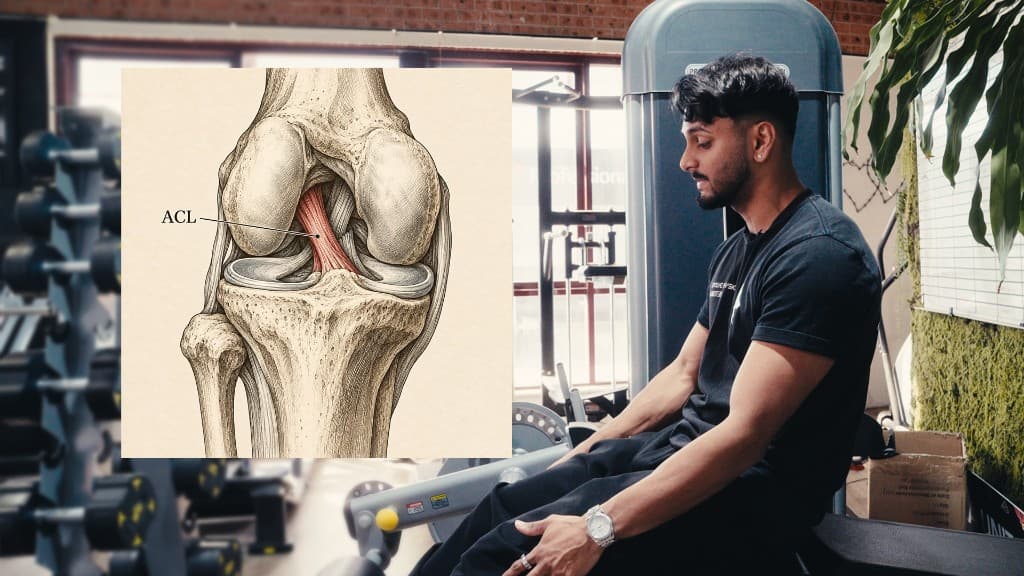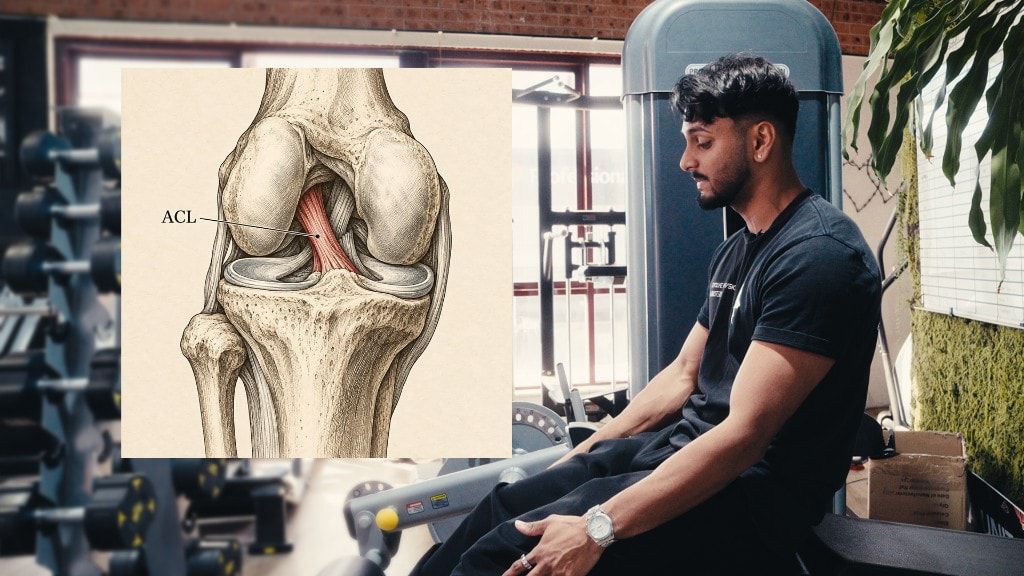
5 Best Exercises After ACL Surgery (The Details That Make Them Work)
Video masterclass
5 Best Exercises for ACL Rehab
Five ACL rehab exercises we use after surgery: sled, knee extension, landing, deceleration and single-leg work — plus the details that make them useful. Watch the full session below — then open the video page for notes, timestamps, and related guides.
Mastery program
The ACL Comeback Program
A structured 28-day knee rehab program designed for people stuck in the "almost better" phase after ACL or meniscus injury. Rebuild strength, restore confidence, and bridge the gap between feeling okay and being fully back.
Run, jump, cut, play — that’s the brief
If your goal is a knee strong enough to run, jump, change direction and get back to sport — or just feel confident using it again — these are five exercises we want somewhere in your recovery.
They are not week-one post-op work. They are not a full ACL protocol by themselves. They are the five we keep seeing missing when someone has “done physio,” can squat a bit, and still doesn’t trust a landing, a brake, or a single-leg plant.
In 5 Best Exercises for ACL we show the drills — and the little details that actually make them useful. Watch on YouTube.
Linda: martial arts and the park
One of our clients, Linda, came to us after ACL and meniscus surgery. Two goals. The first was to get back to martial arts. The second was simpler, and in some ways harder to admit: to play with her kids without her knee and pain constantly holding her back.
She worked her way toward both. That pairing matters. A lot of ACL content only speaks to the athlete who wants a grand final. Plenty of people in our rooms in Cabramatta want that and they want a Saturday that isn’t organised around the knee. If the second one is you, read play with your kids after injury after this.
Want a structured program, not just an article?
This guide gives you the framework. The ACL Comeback Program ($50) is our 28-day lower-limb strength block for the “almost better” phase — when you can walk and do daily life but need progressive loading before you trust running again. Pair it with the free Knee Pain Mastery Guide for day-to-day exercises.
Where these five sit in a real rehab
Use the month-by-month ACL timeline for the calendar. Roughly:
- Early: swelling, extension, quad wake-up, walking. Not this list.
- Mid: sled and extension start to earn a place once closed-chain and (when allowed) open-chain loading are cleared. Single-leg strength in supported forms.
- Later: landing, then deceleration, then the single-leg work looking more like sport. Mental exposure the whole way — not as a speech in week 36.
Do not do all five in one session because they appeared in one video. That is a content structure, not a workout.
1. Sled — tension, not lockout
One of the best ways to get a heap of work through the quads without placing too much strain on the patella tendon. Work a small range. We never go out to extension, because we want tension on the quad at all times. If you finish every step with a snapped-straight knee, you have taken the work off the muscle you came to train.
Heavy enough to matter. Clean enough that the trunk doesn’t steal it. Full sled breakdown →
2. Knee extension — make straightening less scary
Straightening and loading the knee after a graft can feel like the injury again. The machine is how we make that less scary — not by avoiding it. Three progressions: 45° isometric, then 0° isometric, then eccentrics. Holds before movement. Control on the way down before you start heaving the stack.
Open-chain extension has been over-feared. Your surgeon’s timeframe still wins; folklore from a forum does not. How we dose extension →
3. Landing — the knee has to accept force
Strength is important. At some point your knee has to accept force. Start without a box, add a box, then single-leg. You need to face the things that scare you at some point in recovery, otherwise they stay in your head rent-free. The more you avoid landing, the stronger the fear gets.
Height is a dose, not courage. Quiet stick landings beat messy high ones. Landing guide →
Online Rehab Academy
Book a free discovery call
Want this protocol mapped to your injury, scan and timeline? Our Online Rehab Academy pairs video-guided rehab with remote coaching from our clinical team — the same standards as in-clinic care, from home.
Wait — you can do all five and still not be ready
This is the middle of the video, before drills four and five, on purpose. After a serious injury the body progresses, but mentally you still see yourself as injured. You hesitate. You protect that knee. You second-guess movements you never used to think twice about.
When someone finally says “you’re ready — go play,” the first thought often isn’t excitement. It’s “What if I do it again?” That layer gets missed far too often. Gym work without exposure is how people pass tests and freeze in games.
Read the mental piece → Then book 15 minutes with the Online Rehab Academy if you want that mapped, not guessed.
4. Deceleration — learn the brake
You need to learn how to slow down. The easiest drill is running. Use cones so you know when you have to brake. As you improve, make that distance shorter — or increase your running speed. One variable at a time. Change of direction comes after the stop is competent, not instead of it.
Most rehabs train the go. Sport punishes the brake. Decel drills →
5. Single-leg work — sport doesn’t give you two feet
Running is a series of single-leg contacts. Cutting is single-leg dominant. Landing often becomes single-leg. Practise single-leg calf raises, single-leg squats, and single-leg machine work. Two-leg squats let the strong side cheat. Sport will not.
What to do with this if you’re in the middle of it
- Watch the video once through without trying to copy everything.
- Ask your physio which of the five you are actually ready for this month — not which ones look impressive.
- Pick the biggest gap (usually landing, the brake, or honest single-leg strength) and train that with the details above, not a random circuit of all five.
- If the gap is “I’m cleared and I still don’t want to go,” start with the mental post and a discovery call. More quad isolation will not talk you onto the mat.
Linda’s “simple” goal — playing with her kids without the knee running the afternoon — is a valid return-to-sport. Martial arts was the other. You are allowed to want both. That’s the work we do in the rooms and in the Academy.
Buy The ACL Comeback Program or book a free discovery call
The ACL Comeback Program is our paid 28-day lower-limb strength and confidence block ($50). We use it for ACL and meniscus rehabs — and for athletes stuck in the “almost better” phase after knee sprain, giving-way, or a long layoff from running and court sport. It is built for the whole lower limb, not only post-op ACL.
Purchase The ACL Comeback Program →
Want a plan mapped to your scan, sport and timeline without coming in first? Book a free discovery call for our Online Rehab Academy →
Free progressive home loading: Knee Pain Mastery Guide. In Cabramatta / South West Sydney? Book an in-clinic physio assessment.
Frequently Asked Questions
What are the five exercises?
Sled (small-range quad load, no lockout), knee extension (45° iso, 0° iso, then eccentrics), landing/load absorption (no box → box → single-leg), deceleration cone work, and single-leg strength (calf raises, squats, machine work).
Can I do these the week after surgery?
No. They belong in a staged program. Early rehab is swelling, extension and quad wake-up. These five show up when your physio says the knee can take them — often mid to late stage, and not all five in the same month.
Is this a complete ACL program?
No. It is five things we want somewhere in a recovery that also includes gait, range, swelling management, hamstrings, hips, running progression, change of direction, and the mental layer. Treat this as a map of gaps most people skip — not a 12-week PDF.
Who is Linda?
A client who came to us after ACL and meniscus surgery. Goals: martial arts, and playing with her kids without the knee running the day. She worked toward both. The point of the story is that “return to sport” and “ordinary life” are allowed to sit in the same rehab.
Do I need a gym for all five?
Sled and the extension machine want a gym. Landing, deceleration and a lot of single-leg work can start with a cone, a low step and your bodyweight. If you don’t have equipment, we map substitutes on a Rehab Academy call rather than pretending a resistance band is a prowler.
Where do I watch?
YouTube (https://youtu.be/2gGw7P5KREM) or our video library (/video-library/v/5-best-exercises-for-acl). Then book a free Rehab Academy discovery call at /rehab-academy.