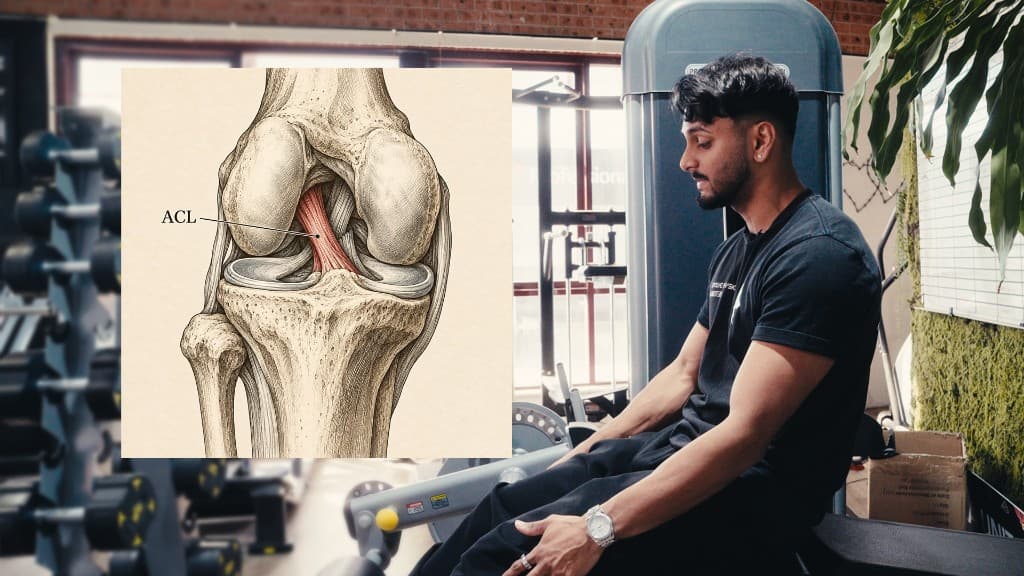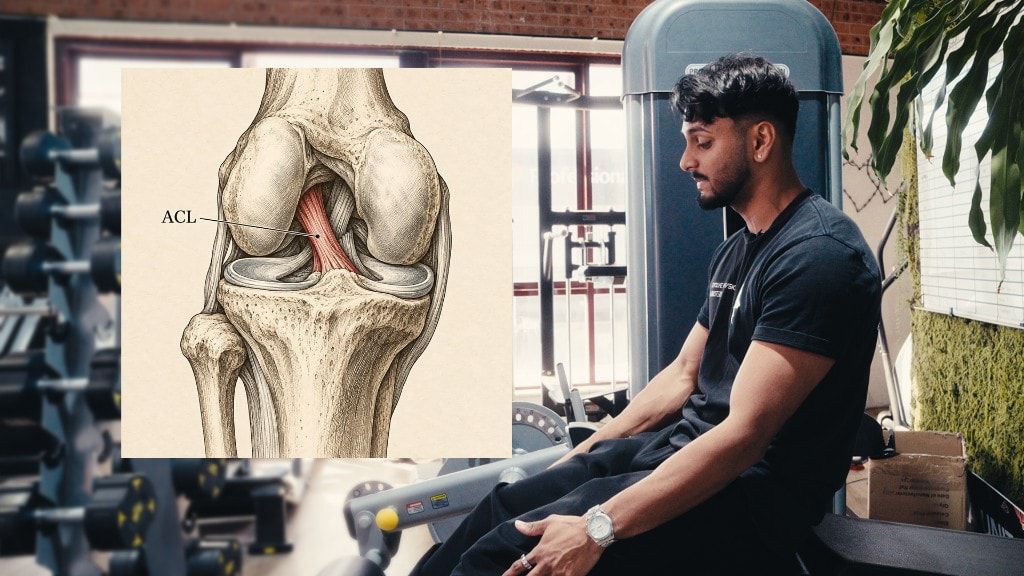
Single-Leg Exercises After ACL Surgery: Sport Doesn’t Give You Two Feet
Video masterclass
5 Best Exercises for ACL Rehab
Five ACL rehab exercises we use after surgery: sled, knee extension, landing, deceleration and single-leg work — plus the details that make them useful. Watch the full session below — then open the video page for notes, timestamps, and related guides.
Mastery program
The ACL Comeback Program
A structured 28-day knee rehab program designed for people stuck in the "almost better" phase after ACL or meniscus injury. Rebuild strength, restore confidence, and bridge the gap between feeling okay and being fully back.
Sport is a single-leg problem
Running is a series of single-leg contacts. Cutting is single-leg dominant. Landing often becomes single-leg. Sport does not give you two perfectly planted feet every time something happens.
So in 5 Best Exercises for ACL we finish on single-leg work: calf raises, squats, machine work — one side at a time. Watch on YouTube.
If you only ever squat with two feet, the graft side can hide. The uninvolved leg is perfectly happy to do 60–70% of the job while you watch the bar go up and call it rehab. Single-leg is where you find out whether the quad actually showed up.
The three families we want in the program
Single-leg calf raises
The calf is the spring in running. After surgery, people protect, shorten the stride, and never fully load the ankle. Then they wonder why the knee feels noisy when they jog. Do them on a step if you have the range; do them on the floor if you don’t. Slow up, slower down. Compare sides. If the operated side is 12 reps and the other is 25, that is not a mystery — that is the session.
Single-leg squats (and the cousins that lead there)
A full pistol is not the entry point. Sit-to-stand shifting toward one leg. Supported split squats. Step-downs off a low box. Rear-foot-elevated splits when the trunk is stable. Then a true single-leg squat to a box you can own. Knee tracks over the foot. Hip shares the work. No corkscrew, no dumping into the inside of the knee, no using the opposite toe as a kickstand you pretend isn’t there.
Single-leg machine work
Leg press one side at a time. Extension one side at a time (when your protocol allows — see the extension post). Hamstring curls one side at a time. Machines let you load without asking the whole body to balance and be brave at the same moment. Use that. Then take some of that capacity onto the floor.
Online Rehab Academy
Book a free discovery call
Want this protocol mapped to your injury, scan and timeline? Our Online Rehab Academy pairs video-guided rehab with remote coaching from our clinical team — the same standards as in-clinic care, from home.
A simple progression we use
- Supported and isometric. Wall-supported single-leg holds, two-leg work with a longer pause on the graft side, calf raises with a fingertip on a bench.
- Through range, slow. Step-downs, split squats, single-leg press. Tempo you can control at the bottom — not a bounce.
- Less support, more range. Lower the box. Take the hand away. Match the other side for reps before you chase load.
- Then hops — if landing is already in the program. Single-leg strength without load absorption is a gym trick. Strength plus a catch is sport.
Stack this with sled so the engine exists before you ask it to hop. Bilateral work can stay in the week for load. It just cannot be the only story.
How much is enough?
We are not hunting a perfect number from a paper you can ignore in the real session. We are hunting sides that look like they belong to the same person.
- Calf raises: work toward matching the uninvolved side for slow reps, then add load (backpack, dumbbell) on the weaker side if reps are already there.
- Step-downs: a height you can do for 8–10 controlled reps without the knee diving in or the hip shooting out.
- Machine: same reps, same tempo; the load on the graft side should climb toward the other side over months, not overnight.
Formal pass/fail belongs in ACL return-to-sport testing — hop tests, strength ratios, change of direction. This post is the training that makes those tests possible. You cannot test your way into a quad you never trained one side at a time.
Common mistakes
- Calling a two-leg squat “unilateral” because you thought about the graft.
- Letting the hip hitch, the foot roll in, or the other toe cheat on every rep.
- Going to failure until the pattern is garbage. Rehab is not a CrossFit finisher.
- Skipping calves because they’re boring, then wondering why running feels sloppy.
- Jumping to single-leg hops because they look like sport, with a squat that still collapses.
Related reading
ACL return-to-sport testing · Landing · The five exercises · Month-by-month timeline
Buy The ACL Comeback Program or book a free discovery call
The ACL Comeback Program is our paid 28-day lower-limb strength and confidence block ($50). We use it for ACL and meniscus rehabs — and for athletes stuck in the “almost better” phase after knee sprain, giving-way, or a long layoff from running and court sport. It is built for the whole lower limb, not only post-op ACL.
Purchase The ACL Comeback Program →
Want a plan mapped to your scan, sport and timeline without coming in first? Book a free discovery call for our Online Rehab Academy →
Free progressive home loading: Knee Pain Mastery Guide. In Cabramatta / South West Sydney? Book an in-clinic physio assessment.
Frequently Asked Questions
Which single-leg exercises after ACL?
Start with what you can control: supported calf raises, sit-to-stand to one leg, then machine work (leg press / extension as allowed), then free squats and hops when criteria say so. The video names the big three families: single-leg calf raises, single-leg squats, single-leg machine work.
Why not just bilateral squats?
The strong side will cheat. Sport will not let it. If you only ever load two feet, the operated side stays the passenger. Two-leg work still has a place for load and confidence — it is not enough on its own.
How do I know the graft side is catching up?
Compare sides on the same drill: calf raise reps to fatigue, step-down quality, leg-press load for the same reps, hop distance later on. Numbers aren’t the whole story — a 10-rep squat that looks like a corkscrew is not “strong.” Quality plus capacity. Return-to-sport testing is where we make that formal.
My calf is fine. Can I skip calf raises?
Usually no. Ankle stiffness and a lazy calf change how the knee takes load when you run. Single-leg calf raises are cheap, revealing, and they show up in every running and jumping pattern. Do them until the sides match, then keep them as maintenance.
When do single-leg squats become single-leg hops?
When you can control a squat/step-down without collapse, the knee is quiet the next day, and your physio has cleared impact. Hops are landing plus single-leg. Earn them in that order — see the landing post before you start bouncing.
Where is this in the video?
Exercise 5 — https://youtu.be/2gGw7P5KREM or /video-library/v/5-best-exercises-for-acl.