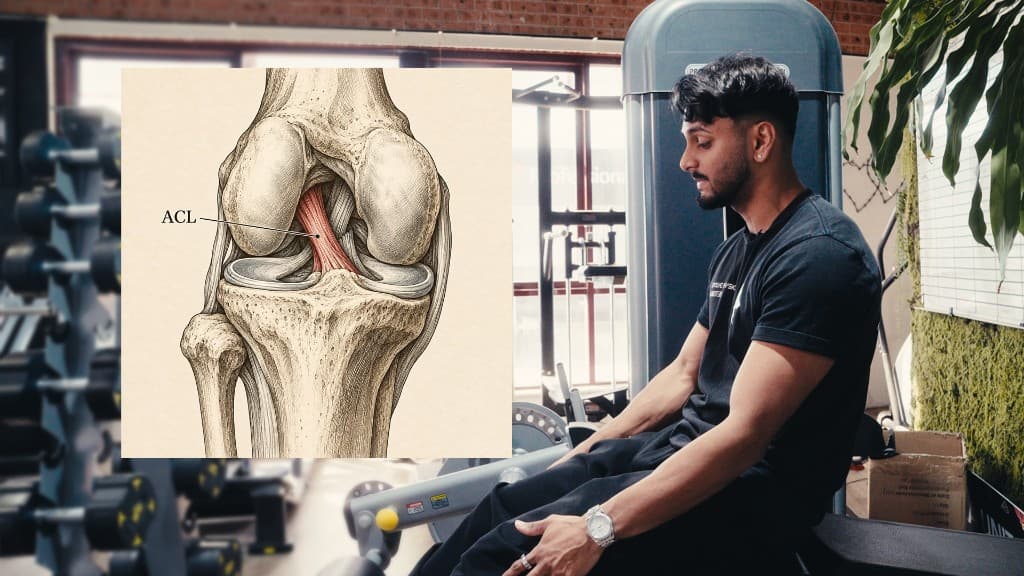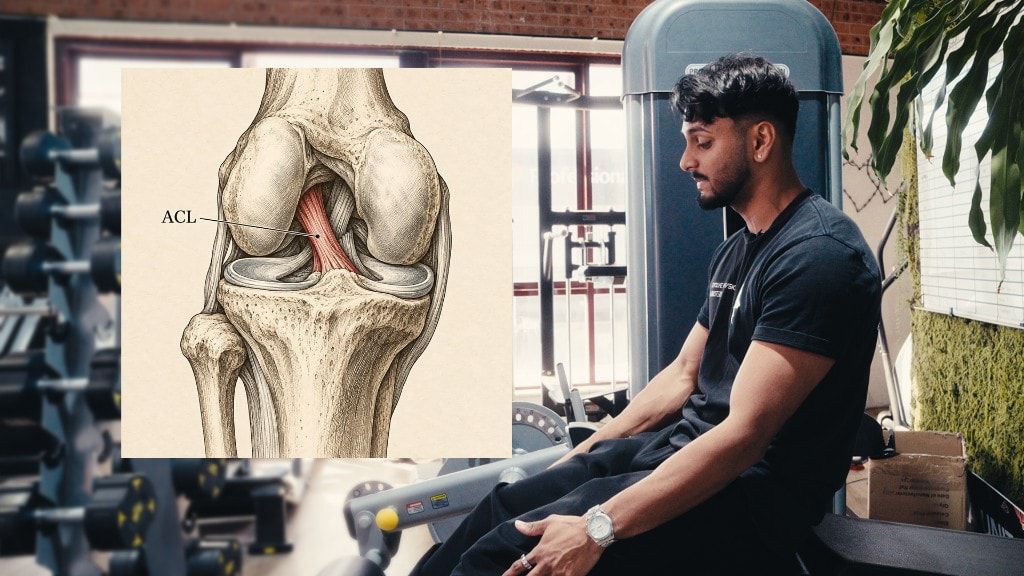
Deceleration After ACL Surgery: Learn to Slow Down Before You Cut
Video masterclass
5 Best Exercises for ACL Rehab
Five ACL rehab exercises we use after surgery: sled, knee extension, landing, deceleration and single-leg work — plus the details that make them useful. Watch the full session below — then open the video page for notes, timestamps, and related guides.
Mastery program
The ACL Comeback Program
A structured 28-day knee rehab program designed for people stuck in the "almost better" phase after ACL or meniscus injury. Rebuild strength, restore confidence, and bridge the gap between feeling okay and being fully back.
You need to learn how to slow down
The easiest drill is running. Put cones where you have to brake. That’s it. Not a fancy agility ladder. A decision: now I stop.
In 5 Best Exercises for ACL, deceleration is exercise four — after you’ve started loading the quad and landing. Watch on YouTube.
Most ACL gym programs train the go: stronger squat, faster linear run, more calf raises. Sport punishes the brake. A cut, a close-out on defence, a sudden stop to avoid a tackle — the knee has to absorb force while it is still travelling forward. If the first time you ask for that is a Tuesday night social game, you have used the match as the rehabilitation session.
Want a structured program, not just an article?
This guide gives you the framework. The ACL Comeback Program ($50) is our 28-day lower-limb strength block for the “almost better” phase — when you can walk and do daily life but need progressive loading before you trust running again. Pair it with the free Knee Pain Mastery Guide for day-to-day exercises.
How to set the drill up
- Mark a run-up. Even 15–20 metres is enough to start.
- Put a cone (or a line, or a bag) where you must start slowing down.
- Jog in. Start the brake before the cone, not on it. The cone is the latest acceptable moment, not the surprise.
- Stop in control. Stick it. Reset. Walk back. Do not turn the walk-back into a sneaky extra cut.
Early sessions look boring on purpose. Conversational pace. Plenty of space to slow down. Two feet, then a slightly more aggressive plant. The film of this should look like someone who meant to stop — not someone who nearly fell over a cone.
How to progress (one variable at a time)
As you improve, make the distance to the cone shorter, or increase running speed. Not both in the same week unless your physio is watching the knee do it.
- Shorter braking distance. Same approach speed, less room to slow down. That raises the force the legs have to produce in less time.
- Higher approach speed. Same room to brake, you’re just arriving faster. Same idea: more force, more demand on the quad and the pattern.
- Later: stop on the operated leg, then add a planned 45° cut after a competent stop — not a wild 180° because a YouTube agility video said so.
Quality of the stop is the program. If the last three steps become a panic shuffle, the knee stiffens, or you spin off the cone, you have exceeded the dose. Move the cone back or slow the run-up. Getting “away with it” is not a green light.
Online Rehab Academy
Book a free discovery call
Want this protocol mapped to your injury, scan and timeline? Our Online Rehab Academy pairs video-guided rehab with remote coaching from our clinical team — the same standards as in-clinic care, from home.
What a good brake looks like
- You started slowing before you had to — not a last-second slam
- Trunk stays roughly stacked; you don’t fold in half or lean back like you’re on ice
- Knees flex to absorb; they don’t snap into a locked, upright emergency stop
- Feet stay under you; you’re not reaching out with a straight leg to spear the ground (that’s a classic ACL-risk pattern)
- You could go again next rep without a limp or a story
This is the same idea as our running protocol and the return to running after ACL guide: races and sports punish the people who only trained acceleration.
When this is too early
If you cannot jog a straight line with a quiet knee, cones are not your next step. Build the quad, own extension, get a walk-run base, then add the brake. Deceleration on a swollen, under-quad’d knee is how people write a new story about “I tried to come back and it didn’t hold.”
Graft timelines still apply. Late-stage running and change of direction sit months after surgery for a reason. The video is showing you the skill we want in the program — not a date on the calendar.
Red flags
- Giving-way or a “not there” feeling on the plant
- Pain on the outside or inside joint line that wasn’t there on straight running
- A stiff, locked landing into the stop (you’re protecting, not training)
- Next-day swelling after a cone session that straight running didn’t cause
Related reading
Landing · Return to running after ACL · ACL return-to-sport testing · All five
Buy The ACL Comeback Program or book a free discovery call
The ACL Comeback Program is our paid 28-day lower-limb strength and confidence block ($50). We use it for ACL and meniscus rehabs — and for athletes stuck in the “almost better” phase after knee sprain, giving-way, or a long layoff from running and court sport. It is built for the whole lower limb, not only post-op ACL.
Purchase The ACL Comeback Program →
Want a plan mapped to your scan, sport and timeline without coming in first? Book a free discovery call for our Online Rehab Academy →
Free progressive home loading: Knee Pain Mastery Guide. In Cabramatta / South West Sydney? Book an in-clinic physio assessment.
Frequently Asked Questions
Why is deceleration a separate drill?
Running in a straight line at one speed is not sport. Non-contact ACL injuries often happen when you slam the brakes, plant, and redirect. If you never practise the brake, the first game is the first exposure.
How do I progress cone deceleration?
Same run-up, shorter distance to the brake — or same distance, higher speed. One variable at a time. Quality of the stop matters more than looking fast. If the last three steps are a panic shuffle and a stiff knee, you went too fast or the cone is too close.
Do I need to be running continuously first?
You need a return-to-run base — not marathon fitness, but the ability to jog with a pattern that doesn’t dump into the knee. If you can’t run a quiet straight line, don’t add a brake. See our return-to-run after ACL guide before you put cones down.
Is this the same as agility ladders and cutting drills?
No. Ladders are foot-speed theatre. Cutting is a later skill that assumes you can already decelerate. We teach the brake first: run, then stop on purpose. Change of direction comes after the stop is competent.
Which leg should I stop on?
Both. Then bias the operated side once two-sided stops are clean. Sport will ask the graft side to be the brake. If you always stop on the uninvolved leg, you have trained a workaround.
Where is the demo?
Exercise 4 in /video-library/v/5-best-exercises-for-acl or https://youtu.be/2gGw7P5KREM.