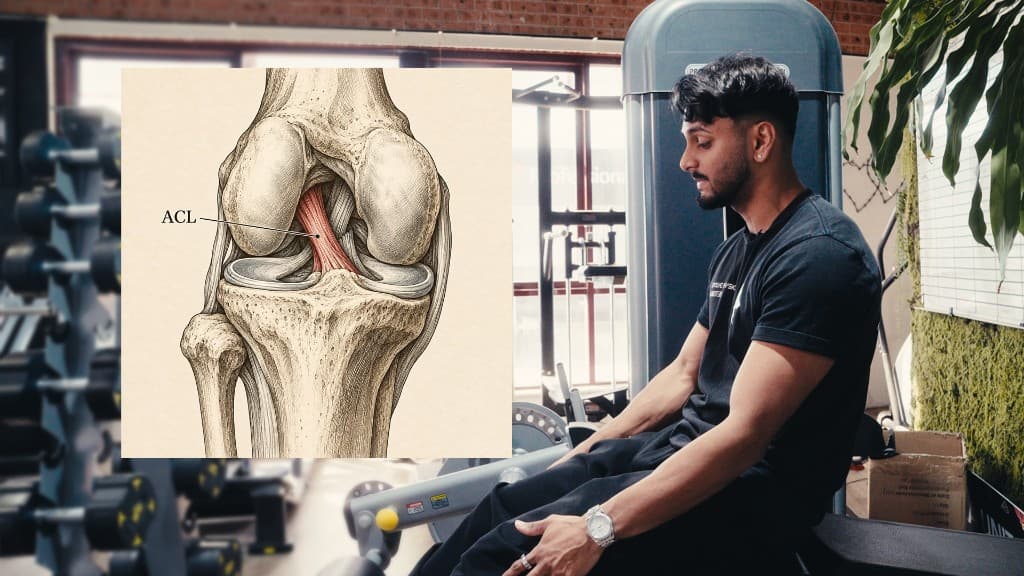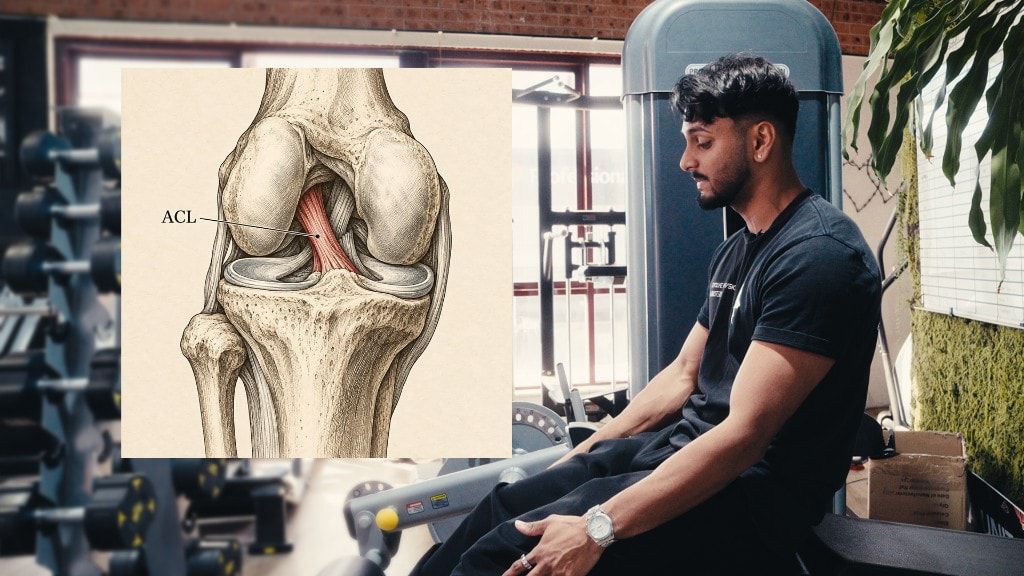
Landing After ACL Surgery: Your Knee Has to Accept Force
Video masterclass
5 Best Exercises for ACL Rehab
Five ACL rehab exercises we use after surgery: sled, knee extension, landing, deceleration and single-leg work — plus the details that make them useful. Watch the full session below — then open the video page for notes, timestamps, and related guides.
Mastery program
The ACL Comeback Program
A structured 28-day knee rehab program designed for people stuck in the "almost better" phase after ACL or meniscus injury. Rebuild strength, restore confidence, and bridge the gap between feeling okay and being fully back.
Strength is important. Then the knee has to accept force.
You can squat forever and still freeze on a landing. That’s not “not strong enough.” That’s a knee that has never been asked to catch the body in space since the injury. Gym strength is slow, predictable, two feet, and you chose the moment. Landing is fast, and the ground does not negotiate.
In 5 Best Exercises for ACL this is exercise three — after you’ve started rebuilding the quad with sled and extension. Watch on YouTube.
ACL injuries often happen when the joint has to accept and redirect force in a split second. If your entire program is slow strength, you have trained a different sport. Load absorption is the bridge between “I can lift” and “I can play.”
The progression: no box, then a box, then single-leg
1. Start without a box
Learn to absorb force from almost no height. A small jump in place. A step-off a 5–10 cm plate. A drop from standing onto two feet where the only job is a quiet stick. You are teaching the knee the skill of catching, not the skill of looking plyometric on Instagram.
Coaching we use: land as quietly as you can; knees over mid-foot, not diving inward; hips help — don’t let the knees do 100% of the fold; stick it for a second before you reset. If you can’t stick it, the drop is too high or the strength underneath isn’t there yet.
2. Add a box
Now height is a dose. The box is not a badge. A 20 cm drop you own is worth more than a 60 cm drop you survive. We raise the box when the landing is consistently quiet and the knee is not swollen the next morning — not when you’re bored.
Drop-lands (step off, absorb) are usually the first box drill. Jumping onto a box is a different skill and often easier on the landing because the box shortens the drop. Don’t confuse “I can jump on a box” with “I can land from the air.” We care more about the second.
3. Single-leg
Sport does not give you two perfectly planted feet. Cutting, an awkward bounce, a mid-air bump — one leg does the job. We only go here when two-foot work is competent. Then: small single-leg hop in place, step-down and stick, then a very small single-leg drop. Same cues. Much less height than your two-foot box. Ego stays on the floor.
Online Rehab Academy
Book a free discovery call
Want this protocol mapped to your injury, scan and timeline? Our Online Rehab Academy pairs video-guided rehab with remote coaching from our clinical team — the same standards as in-clinic care, from home.
Avoidance makes the fear stronger
You need to face the things that scare you at some point in recovery, otherwise they stay in your head rent-free. The more you avoid landing, the bigger the story gets. That is not a character flaw. That is how threat works. The nervous system learns “we don’t do that any more,” and then a physio with a clipboard wonders why you passed strength tests and still flinch.
This is also where people look “cleared” on paper and still freeze. Pair the drill with the mental layer: what if I do it again? The landing session is part of the mental work if you dose it as exposure instead of as a toughness contest.
Related: fear of re-injury after ACL.
Readiness checks before you hop
- Swelling is mostly quiet and doesn’t blow up after a strength session
- You can straighten the knee and you have a quad that can actually work in that range
- Single-leg squat or a controlled step-down without the knee diving in
- You can hop on the uninvolved side and know what “athletic” feels like — then we build toward that on the graft side, we don’t copy the height day one
- Your physio has said impact is allowed. Graft timelines are not all identical. Hamstring vs patella-tendon vs quad grafts change what the front of the knee will tolerate.
Red flags — drop the height, or stop
- Giving-way, or a feeling that the knee “isn’t there” on contact
- Sharp pain in the joint line, graft site, or patella tendon that wasn’t there at the start of the session
- Swelling the next morning that wasn’t your baseline
- A landing you can’t stick — extra stutter-steps, a limp, or a full flinch
- Holding your breath and bracing for every rep as if the floor is a threat. That’s a smaller drill, not a pep talk.
How it fits the five
Landing is useless if the quad isn’t there — that’s why sled and extension come first in the video. After landing, you still need deceleration (the brake in the horizontal plane) and single-leg strength so the catch has an engine underneath it. See all five in the hub.
Buy The ACL Comeback Program or book a free discovery call
The ACL Comeback Program is our paid 28-day lower-limb strength and confidence block ($50). We use it for ACL and meniscus rehabs — and for athletes stuck in the “almost better” phase after knee sprain, giving-way, or a long layoff from running and court sport. It is built for the whole lower limb, not only post-op ACL.
Purchase The ACL Comeback Program →
Want a plan mapped to your scan, sport and timeline without coming in first? Book a free discovery call for our Online Rehab Academy →
Free progressive home loading: Knee Pain Mastery Guide. In Cabramatta / South West Sydney? Book an in-clinic physio assessment.
Frequently Asked Questions
When do I start jumping after ACL reconstruction?
After you have quiet swelling, decent quad, a landing pattern you can control at a lower height, and your physio has cleared impact. Jumping is earned. Copies of Instagram plyos are how people flare grafts and tendons. If you cannot control a small drop, you are not ready for a box.
Why start without a box?
You learn to absorb force from a small drop first — even from standing, a tiny hop, or stepping off a low plate. The box is a dose, not a personality test. Height is not courage.
What does a good landing look like?
Quiet feet, knees tracking over the feet (not collapsing in), hips sharing the work, and the ability to stick it without a second stutter-step. Stiff, locked-out landings dump force into the joint. Excessively soft, folding landings dump it into a pattern you won’t use in sport. We want controlled and athletic — not either extreme.
When do I go single-leg?
When two-foot landings are boringly competent: consistent, quiet, no valgus collapse, no next-day swelling. Then a very small single-leg hop or step-down land. Sport will not give you two perfect feet, so we get there — we just don’t start there.
Landing makes me panic even when it doesn’t hurt. Is that still a physio problem?
Yes. Avoidance keeps the fear in your head rent-free. Graded exposure — the same drill, smaller — is the treatment. Pair it with the mental piece: you can do every gym exercise and still freeze on a landing.
Where is this in the video?
Exercise 3 — https://youtu.be/2gGw7P5KREM or /video-library/v/5-best-exercises-for-acl.