Sled Pushes After ACL Surgery: Quad Strength Without Beating Up the Tendon
Video masterclass
5 Best Exercises for ACL Rehab
Five ACL rehab exercises we use after surgery: sled, knee extension, landing, deceleration and single-leg work — plus the details that make them useful. Watch the full session below — then open the video page for notes, timestamps, and related guides.
Mastery program
The ACL Comeback Program
A structured 28-day knee rehab program designed for people stuck in the "almost better" phase after ACL or meniscus injury. Rebuild strength, restore confidence, and bridge the gap between feeling okay and being fully back.
Heavy quads, quieter tendon
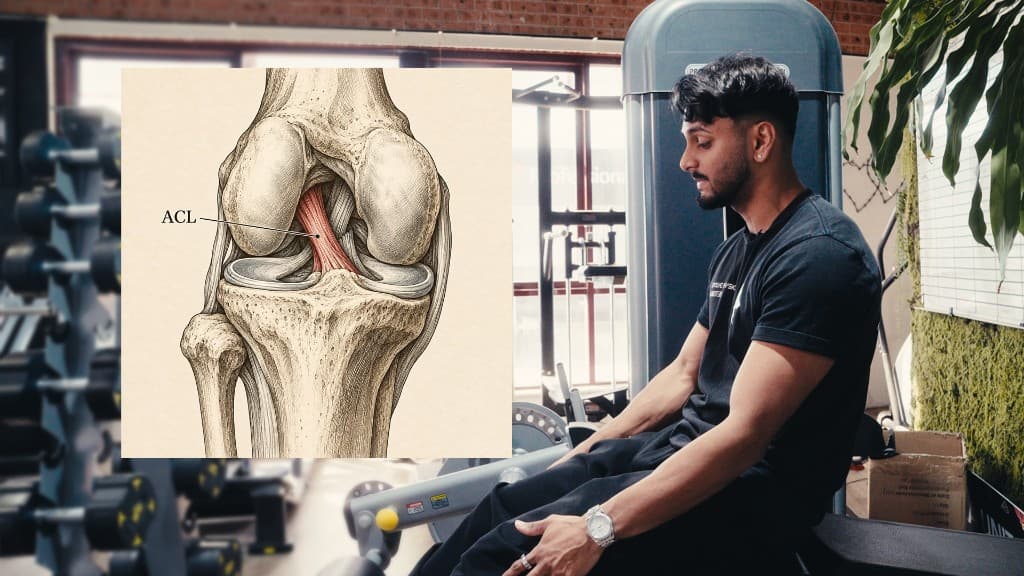
After ACL reconstruction, the quad is the muscle that goes quiet. Arthrogenic inhibition is not a motivation problem — the joint has been through surgery, swelling, and months of the nervous system treating that thigh like a threat. Meanwhile the patella tendon is the structure people aggravate when they jump straight into deep, angry knee-extension work because someone told them “just squat more.”
In 5 Best Exercises for ACL, the sled is exercise one for a reason: you can get a heap of work through the quads without placing too much strain on the patella tendon. Watch on YouTube.
That is the trade we want in mid-stage ACL rehab. Closed-chain, high volume, high tension, relatively kind to the front of the knee. It is not a magic graft-healer. It is a clean way to rebuild the engine that running, cutting and landing will later ask for.
Want a structured program, not just an article?
This guide gives you the framework. The ACL Comeback Program ($50) is our 28-day lower-limb strength block for the “almost better” phase — when you can walk and do daily life but need progressive loading before you trust running again. Pair it with the free Knee Pain Mastery Guide for day-to-day exercises.
The detail that actually makes it useful
Work through a small range of movement. Don’t chase full lockout. We never go out to extension because we want tension on the quad at all times. If the knee is hanging straight at the top, you’ve taken the work off the muscle you came to train.
That’s the opposite of the gym cue “more range is always better.” Here, range is a tool. Tension is the goal. Think of a slightly bent knee the whole trip — a quarter-squat march, not a sprint that finishes with a snapped-straight leg every step.
- Stay short. Small steps. You should feel the quad working on every contact, not bouncing between lockouts.
- Stay stacked. Ribs over pelvis. If you fold at the hips and shove with your back, the quad has clocked off.
- Stay honest on the operated side. The uninvolved leg will try to do extra. Slow down until both sides look like the same drill.
- Stop before the pattern dies. The last two metres of a sloppy push do not count as rehab. They count as practising a worse pattern.
How we usually dose it
Exact loads depend on your graft, week, swelling and what else is in the session. The pattern we use most often:
- Frequency: 2–3 times per week once you’re cleared for this kind of loading — not every day on top of heavy extension and plyos.
- Volume: several short trips (think 20–40 metres, or 6–10 hard marches) rather than one heroic length of the car park.
- Rest: enough that the next trip still has tension. If you’re gasping and the knee is snapping straight, you are not training the quad any more.
- Progression: more plates only when the small range is automatic. Then slightly longer trips. Then, much later, a bit more speed. Not all three in the same week.
If the front of the knee lights up in a sharp, tendon-y way during or the morning after, that is information. Drop load, shorten the range further, and get it checked. A sled that beats up the patella tendon has missed the entire point of choosing a sled.
Online Rehab Academy
Book a free discovery call
Want this protocol mapped to your injury, scan and timeline? Our Online Rehab Academy pairs video-guided rehab with remote coaching from our clinical team — the same standards as in-clinic care, from home.
When it is too early
Do not copy this from the video in week one after surgery. Early ACL work is swelling control, getting extension back, waking the quad up, and walking like a human. A loaded sled belongs after your physio and surgeon protocol allow closed-chain loading — usually once the knee is relatively quiet, you can extend it, and a limp is no longer the main event.
If you still cannot get the knee straight on the table, fix that first. A bent knee that never reaches extension is a different problem. The sled’s “don’t lock out” cue is for people who can lock out and are using a small range on purpose — not for people who are stuck short of straight.
Common mistakes
- Turning it into a race. Speed is a later variable. Tension is the current one.
- Upright, locked-out “walks” with a plate on the sled. That’s a walk. We wanted a quad exercise.
- Only pushing with the good leg and letting the graft side trail.
- Doing sled, heavy extension, jumping and cutting in the same session because the video listed five things. The video is a menu for a program, not a single workout.
How it fits the five
Sled builds the engine. Then you still need machine extension to own straightening, landing so the knee can accept force, deceleration so you can brake, and single-leg work because sport will not give you two feet. One drill does not make a comeback.
For where this sits month-by-month, see the ACL reconstruction timeline. For the full five-exercise map, start at the hub.
Buy The ACL Comeback Program or book a free discovery call
The ACL Comeback Program is our paid 28-day lower-limb strength and confidence block ($50). We use it for ACL and meniscus rehabs — and for athletes stuck in the “almost better” phase after knee sprain, giving-way, or a long layoff from running and court sport. It is built for the whole lower limb, not only post-op ACL.
Purchase The ACL Comeback Program →
Want a plan mapped to your scan, sport and timeline without coming in first? Book a free discovery call for our Online Rehab Academy →
Free progressive home loading: Knee Pain Mastery Guide. In Cabramatta / South West Sydney? Book an in-clinic physio assessment.
Frequently Asked Questions
When can I start sled work after ACL surgery?
Once your physio and surgeon protocol allow loaded closed-chain work — typically after early swelling and extension are under control, you can walk without a major limp, and the graft-protection phase your surgeon set has been cleared. It is not a week-one drill for everyone.
Why not lock the knee out on the sled?
Locking into full extension dumps tension off the quad. We keep a small range so the muscle stays loaded the whole time — that’s the point of the drill. If the knee hangs straight at the top of the step, you’ve taken the work off the muscle you came to train.
Forward sled or backward sled after ACL?
Both can load the quad. We like a push or march where you can keep the knees slightly bent the entire way. Backward sleds are often even more quad-dominant. The cue is the same: small range, constant tension, no snap to lockout.
I don’t have a sled. What do I do instead?
A wall sit, Spanish squat, or heavy slow split squat can load the quad without a deep, angry knee-extension pattern. They are not identical. If you’re in a commercial gym, ask for the prowler. If you’re training at home, get this mapped on a Rehab Academy call rather than guessing YouTube substitutes.
How heavy should the sled be?
Heavy enough that the quad is clearly working, light enough that your trunk doesn’t take over, your steps don’t get sloppy, and the knee doesn’t snap straight. If you can’t keep the small range, strip plates. Quality of tension beats looking impressive for 10 metres.
Where is this shown?
Exercise 1 in “5 Best Exercises for ACL” — https://youtu.be/2gGw7P5KREM or /video-library/v/5-best-exercises-for-acl.