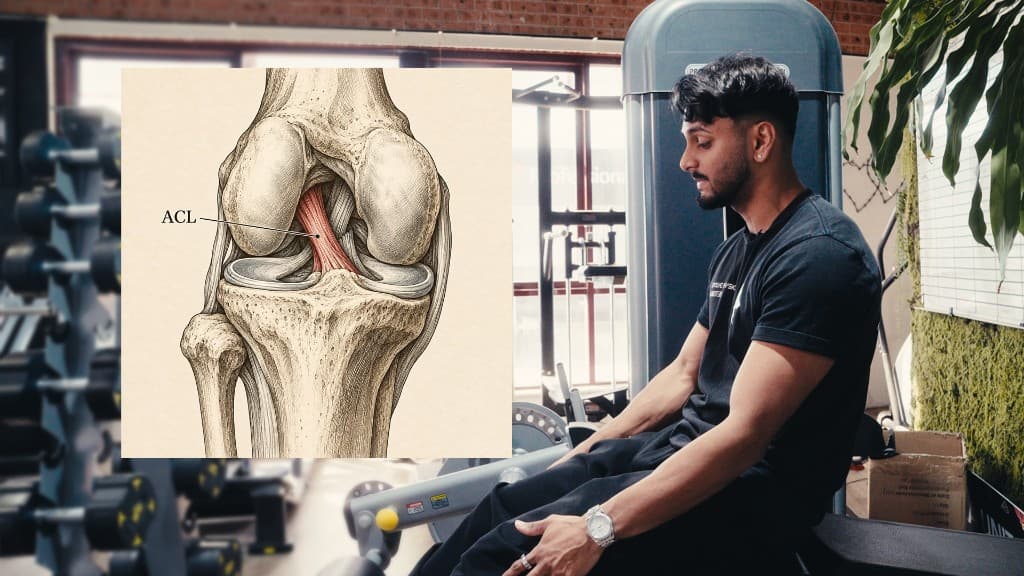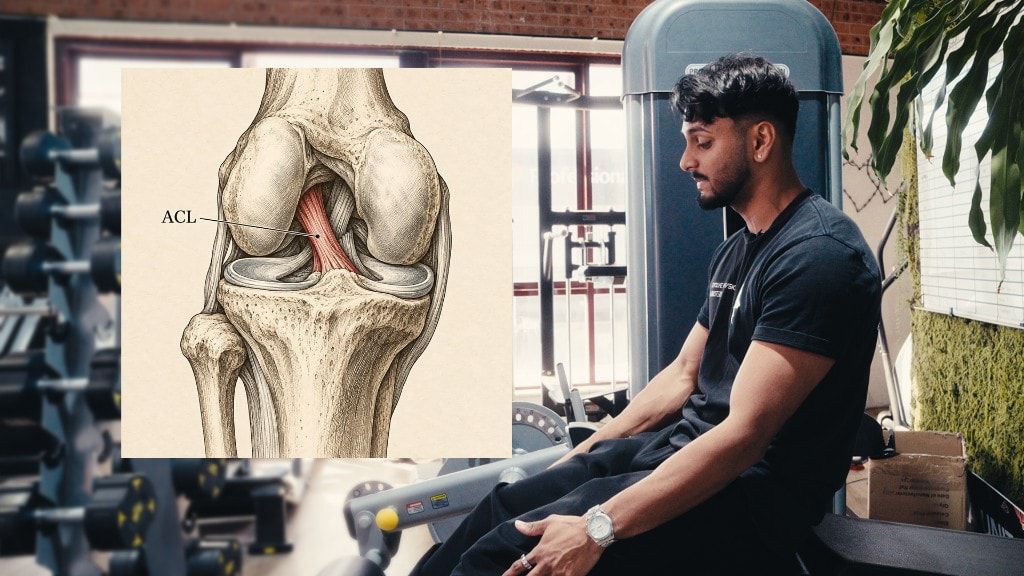
Knee Extension After ACL Surgery: 45° Iso, 0° Iso, Then Eccentrics
Video masterclass
5 Best Exercises for ACL Rehab
Five ACL rehab exercises we use after surgery: sled, knee extension, landing, deceleration and single-leg work — plus the details that make them useful. Watch the full session below — then open the video page for notes, timestamps, and related guides.
Mastery program
The ACL Comeback Program
A structured 28-day knee rehab program designed for people stuck in the "almost better" phase after ACL or meniscus injury. Rebuild strength, restore confidence, and bridge the gap between feeling okay and being fully back.
Straightening can feel like the injury again
After a graft, asking the knee to fully straighten under load is one of the scariest feelings in rehab. The last time the joint went there, something terrible happened — or the first weeks after surgery made extension feel like a threat. People protect. They cheat. They skip the machine because a friend said “leg extensions wreck your ACL.”
In 5 Best Exercises for ACL we say the opposite: this machine is going to be your best friend — if you use it in the right order. Watch on YouTube.
Open-chain knee extension got a reputation in the 90s and early 2000s. Some of that was graft-protection caution for specific ranges and timeframes. A lot of it became folklore. Isolated quad work is one of the few ways to stop the uninvolved side from doing 70% of a squat while the graft side poses. The machine does not have an opinion about your ACL. Load, range, graft type and week do.
Want a structured program, not just an article?
This guide gives you the framework. The ACL Comeback Program ($50) is our 28-day lower-limb strength block for the “almost better” phase — when you can walk and do daily life but need progressive loading before you trust running again. Pair it with the free Knee Pain Mastery Guide for day-to-day exercises.
The three progressions we actually use
This is the sequence from the video. Do not skip to the one that looks like “real lifting.”
1. 45° isometric
Set the machine so you are holding around mid-range — roughly a 45° knee angle. Quad on. No bouncing. You are not fighting the very end of straight yet. Breathe. The goal is a quiet, honest contraction you could repeat, not a personal-best shake for eight seconds.
Why start here: it is usually less threatening than lockout, the patella tracks in a range most people can tolerate, and you can load the quad without the story of “what if it gives.”
2. 0° isometric
Same idea, near full straight. This is where the quad has been hiding. Terminal extension is the range people lose after ACL surgery and the range they keep losing if they only ever squat to a box and never own the last 20°.
Hold. Do not hyperextend into a dumped-back knee. “Straight” means the quad is working to keep it there — not that you’ve hung on the joint and switched the muscle off. That last distinction is the whole drill.
3. Eccentrics
Now the weight moves. You control the lowering. Three to four seconds down is a reasonable starting tempo. The lowering is where people usually panic and drop the stack. Owning that path is how you stop treating straightening as an event that happens to you.
Concentric (lifting up) can come in once the eccentric is clean. If you only ever heave the weight up and crash it down, you have trained the opposite of control.
How we dose it in clinic
- Isometrics: 3–5 holds of 30–45 seconds, full rest (often 45–90 seconds). Load that you can keep without breath-holding your way through a cheat.
- Eccentrics: 3 sets of 6–8 slow lowers, then assist or use the other leg to reset if you can’t control the way back up yet.
- Frequency: 2–3 sessions a week, not stacked on the same day as your first landing session until the knee has shown you it can handle both.
- Progression: longer holds → slightly heavier holds → add eccentrics → add controlled concentrics → then, much later, more conventional set-and-rep work through a larger range.
Swelling the next morning, a hotter knee, or a tendon that hates stairs after session is a dose problem. Drop load or drop range. Do not “push through” a cranky graft or a cranky patella tendon because the video made extension look friendly. Friendly is the order. The load is still a decision.
Online Rehab Academy
Book a free discovery call
Want this protocol mapped to your injury, scan and timeline? Our Online Rehab Academy pairs video-guided rehab with remote coaching from our clinical team — the same standards as in-clinic care, from home.
What “scary” is allowed to mean
Scary is not a reason to skip it. Scary is a reason to dose it. There is a difference between “this feels like a lot and I am concentrating” and “this feels like the injury.” The first is exposure. The second is a stop.
If your whole body braces, you hold your breath, and you cannot put the leg down normally after the set, the load was too high or the range was too far. Go back to 45° isos. That is not failure. That is how you make the machine a friend instead of another thing you avoid until return-to-sport testing.
This pairs with the mental layer: you can be cleared and still afraid. Straightening under load is often the first place that fear shows up in the gym — long before anyone hands you a ball.
Common mistakes
- Starting with 12 swinging reps because that’s what the bloke next to you is doing.
- Using so much body English that the hip and trunk do the lift.
- Stopping 20° short of straight forever because lockout “feels weird.” Weird is the range we need, in doses.
- Ignoring a surgeon’s open-chain restriction, or the opposite — never touching the machine years later because of a 2003 forum post.
Related reading
Sled for quads · Still afraid after clearance · All five exercises · Month-by-month ACL timeline
Buy The ACL Comeback Program or book a free discovery call
The ACL Comeback Program is our paid 28-day lower-limb strength and confidence block ($50). We use it for ACL and meniscus rehabs — and for athletes stuck in the “almost better” phase after knee sprain, giving-way, or a long layoff from running and court sport. It is built for the whole lower limb, not only post-op ACL.
Purchase The ACL Comeback Program →
Want a plan mapped to your scan, sport and timeline without coming in first? Book a free discovery call for our Online Rehab Academy →
Free progressive home loading: Knee Pain Mastery Guide. In Cabramatta / South West Sydney? Book an in-clinic physio assessment.
Frequently Asked Questions
Is the leg-extension machine safe after ACL reconstruction?
Used in the ranges and loads your physio sets, yes — it’s one of the cleanest ways to load the quad. Open-chain extension has been over-feared; the graft cares about load, range, graft type and timing, not the machine’s reputation. Some surgeons still restrict early open-chain work — follow that protocol, then use the machine when you’re allowed.
Why isometrics before eccentrics?
Holding at 45° and at 0° lets you load without the scare of a moving weight. You prove to the knee (and to yourself) that tension is allowed. Once that feels honest, eccentrics teach the quad to control the way down — the part people usually dump.
What does 45° and 0° actually mean?
45° is a mid-range hold — knee bent, not at the bottom of a deep extension, not locked. 0° is near full straight. We use mid-range first because it is usually less threatening, then we take the hold out to the range the quad has been hiding from.
How long do I hold the isometrics?
A common starting dose is 3–5 holds of 30–45 seconds at a load you can keep without shaking into a cheat, with full rest between. If the knee swells or the tendon is angry the next morning, you went too hard or too long — not “you weren’t tough enough.”
My surgeon said no open-chain extension for three months. Now what?
Then you wait, and you load the quad other ways your protocol allows — often closed-chain work, isometrics in protected ranges, and the sled. The machine is a tool for a phase, not a personality test. When the restriction lifts, start at 45° isos, not a stack of plates for 12 noisy reps.
Where is the demo?
Exercise 2 in the ACL five: /video-library/v/5-best-exercises-for-acl or YouTube (https://youtu.be/2gGw7P5KREM).