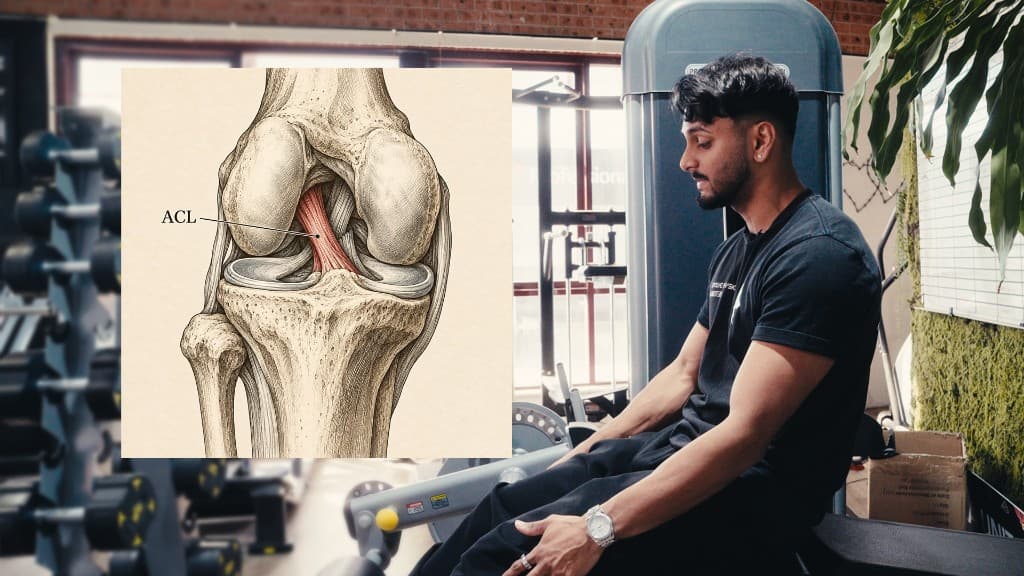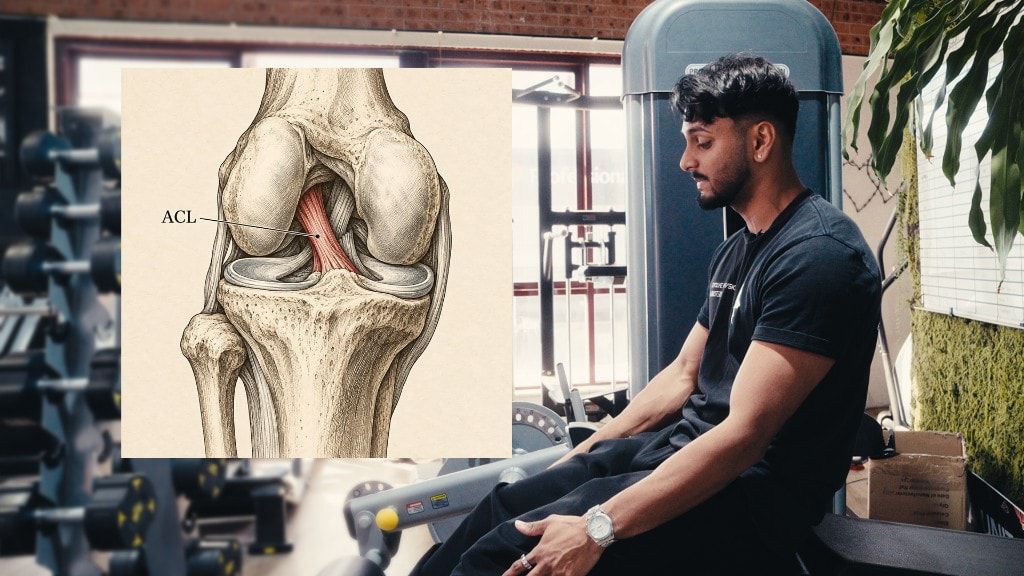
You’re Cleared After ACL Surgery — Why the First Thought Is “What If I Do It Again?”
Video masterclass
5 Best Exercises for ACL Rehab
Five ACL rehab exercises we use after surgery: sled, knee extension, landing, deceleration and single-leg work — plus the details that make them useful. Watch the full session below — then open the video page for notes, timestamps, and related guides.
Mastery program
The ACL Comeback Program
A structured 28-day knee rehab program designed for people stuck in the "almost better" phase after ACL or meniscus injury. Rebuild strength, restore confidence, and bridge the gap between feeling okay and being fully back.
The body moves. The identity doesn’t.
After a serious injury like an ACL tear, your body progresses — but mentally you still see yourself as injured. You hesitate. You protect that knee. You second-guess movements you never used to think twice about.
And when someone finally says, “Alright… you’re ready. Go play,” your first thought isn’t excitement. It’s “What if I do it again?”
That’s the part of rehab that gets missed far too often. We say it in the middle of 5 Best Exercises for ACL — then we still finish the physical list, because both layers matter. Watch on YouTube.
The interruption in that video is deliberate. You could be nodding along to sled and extension, feeling like this is a gym list you can tick — and then the actual blocker shows up. Not a lack of exercises. A lack of a plan for the person who still thinks of themselves as broken.
You can do every exercise in the video and still not be ready
That line is the whole post. Strength can be there. Hop tests can be close. A surgeon can be happy with the graft. And you can still take a shorter stride on the operated side, pull out of a contest you would have won two years ago, or say yes to the game and play like someone waiting for disaster.
Hesitation is not laziness. Protection is not non-compliance. Second-guessing is what a nervous system does when the last time that movement pattern appeared in your life, it ended in surgery, crutches, and months of watching other people train.
If you only treat that with “be confident,” you are asking a slogan to do a clinician’s job. Confidence is a side effect of evidence. Evidence is reps of the scary thing, at a dose you can succeed at, repeated until the story updates.
Online Rehab Academy
Book a free discovery call
Want this protocol mapped to your injury, scan and timeline? Our Online Rehab Academy pairs video-guided rehab with remote coaching from our clinical team — the same standards as in-clinic care, from home.
The physical list is also the mental list — if you use it that way
This is why the five exercises are not only a strength program:
- Straightening under load is often the first “this feels like the injury” moment in the gym. Isometrics let you stay in that feeling without the weight running away from you.
- Landing is the one people skip because avoidance is easier than a quiet drop. The video’s line is the protocol: face it, or it stays in your head rent-free. The more you avoid it, the stronger it gets.
- Deceleration is the game-speed version of the same problem. The brake is where ACLs go. Practising the brake on a Tuesday, in a dose you own, is how Friday stops being a coin flip.
- Single-leg work removes the hiding place. You cannot be “fine on two legs” and ready for a sport that is one leg at a time.
If you use those drills as a checklist to get tired, you will get fitter and stay scared. If you use them as graded exposure — smaller, successful, then a little more — the identity has something new to believe.
What we do with that 15-minute call
If you want this injury to become the thing that built you — not the thing that owns you — you need a plan for the mind as well as the quad. That’s what the Online Rehab Academy discovery call is for: 15 minutes, mapped to your scan, sport, and the fear you don’t put on Instagram.
We are not going to tell you fear is irrational. A second ACL is a real possibility; pretending otherwise is how people feel gaslit by their own rehab. We are going to ask whether your current week includes any successful exposure to the things you will actually have to do — or whether you are hoping gym numbers will speak on your behalf in a match they have never attended.
Some people need more than physio. If the original injury still sits in your body like a tape loop — panic, nightmares, total avoidance — that can be closer to trauma. Read PTSD after ACL surgery and get the right professional in the room. Cone drills do not replace that. They also don’t become irrelevant because a psychologist is involved. You usually need both.
A practical week if you’re “cleared” and still not going
- Write the scene you’re actually afraid of (the cut, the landing, the first whistle) — not “sport” in general.
- Find the smallest version of that scene you can succeed at this week. A stick landing. A jog to a cone and a stop. A single-leg squat that looks like the other side.
- Do it often enough that boredom starts to compete with fear. Then take one step up. Not ten.
- Keep the strength work. Fear is not a reason to abandon the quad. It is a reason to stop pretending the quad was the only thing missing.
Related: fear of re-injury after ACL · the five exercises · return-to-sport testing.
Buy The ACL Comeback Program or book a free discovery call
The ACL Comeback Program is our paid 28-day lower-limb strength and confidence block ($50). We use it for ACL and meniscus rehabs — and for athletes stuck in the “almost better” phase after knee sprain, giving-way, or a long layoff from running and court sport. It is built for the whole lower limb, not only post-op ACL.
Purchase The ACL Comeback Program →
Want a plan mapped to your scan, sport and timeline without coming in first? Book a free discovery call for our Online Rehab Academy →
Free progressive home loading: Knee Pain Mastery Guide. In Cabramatta / South West Sydney? Book an in-clinic physio assessment.
Frequently Asked Questions
Is it normal to be scared when I’m cleared?
Yes. Clearance is mostly physical criteria — strength, hop tests, time since surgery. Confidence is built by graded exposure: landing, decelerating, single-leg work — plus a plan for the story in your head. Being cleared and being ready are not the same sentence.
Can I skip the mental work if my gym numbers are good?
You can. Plenty of people do — then they hesitate on the first cut. The video is blunt: you can do every exercise and still not be ready. The gym does not automatically update your identity from “injured person” to “athlete.”
Is this the same as PTSD after ACL surgery?
Sometimes the fear is a passing hesitation. Sometimes it is closer to trauma — flashbacks of the moment, panic on similar plays, avoiding the sport entirely. If that’s you, read our PTSD after ACL piece and get proper psychological support alongside physio. We don’t pretend a cone drill replaces that.
What actually reduces the “what if I do it again” thought?
Repeated, successful exposures at a dose you can own — not one heroic session. Landings you stick. Brakes you control. Single-leg work that looks like the other side. Plus naming the thought instead of pretending you’re fine because a surgeon signed a form.
What’s the 15-minute call?
A free discovery call for our Online Rehab Academy — we map physical and mental rehab to your surgery, sport and timeline. Start at /rehab-academy.
Where is this in the video?
In the middle of “5 Best Exercises for ACL” — /video-library/v/5-best-exercises-for-acl — before deceleration and single-leg work, on purpose. The interruption is the point.