Shoulder Pain Reaching Behind Your Back: Seatbelt, Bra Strap, and Wallet Pain
Free program
The Shoulder Mastery Guide
MMA Rehab Guide for Shoulder Dislocations!
The reach that quietly ruins your week
People rarely walk in saying “I have lost internal rotation.” They say: I cannot do the seatbelt. I cannot fasten a bra. I cannot get my wallet. I cannot tuck in a shirt. Those are the same movement — hand behind the back — and they are one of the most common functional complaints we see at Evolve Physio & Mastery in Cabramatta, from Liverpool, Fairfield and Bankstown as much as from the golf club or the gym.
It is also one of the most under-trained positions. Most gym programs live in front of the body. Most desk days live with the arms in front of a keyboard. Then life asks for one clean reach behind you and the cuff complains.
What is actually being asked of the shoulder
Hand-behind-back is not a simple stretch. The humeral head has to spin and glide, the scapula has to posteriorly tilt and rotate, and the rotator cuff has to centre the ball while you add a bit of extension. If the mid-back is stiff, the scapula is dumped forward from desk work, or the cuff is already irritable from overhead or tackle sport, this position is the first to fail.
- Rotator cuff irritation — especially after a spike in gym, swimming, or overhead work. See our rotator cuff and impingement guide.
- Posterior capsule / internal-rotation tightness — common in throwers, racquet sports and anyone who benches more than they rotates.
- Scapular control — a dumped or winged scapula steals rotation before the joint has a chance.
- True stiffness — including early frozen shoulder if external rotation and elevation are disappearing too.
What we do first (and what we do not do)
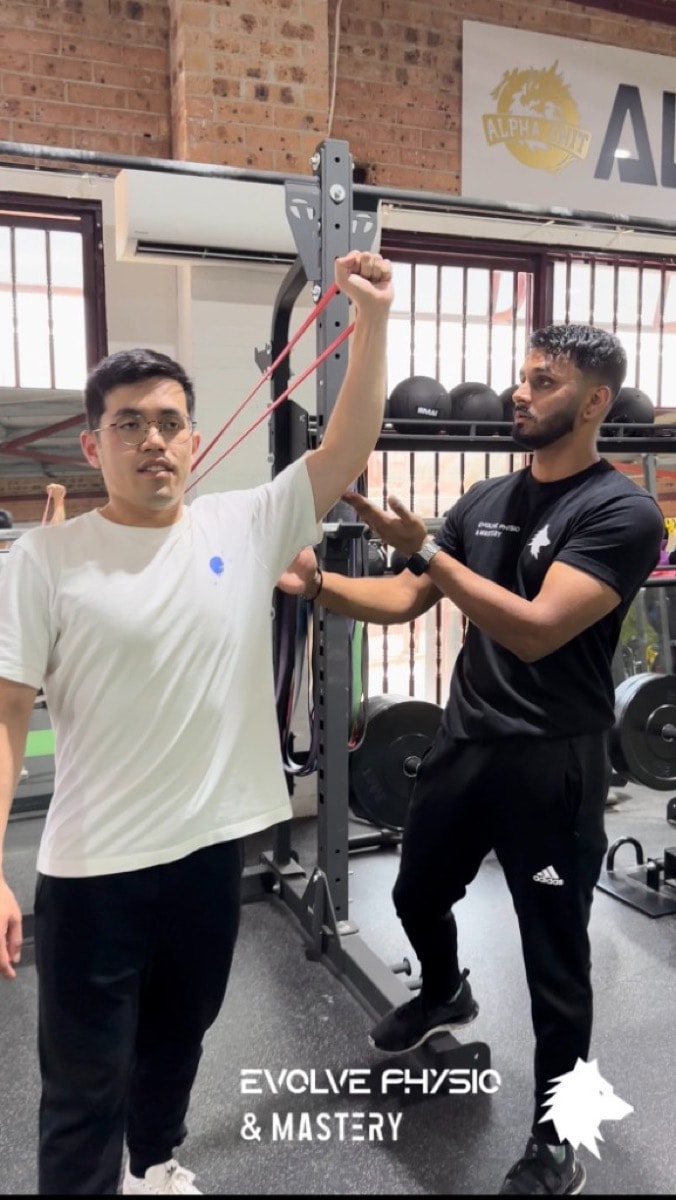
We do not yank the arm up the spine on day one. We check red flags, night pain, true weakness and instability history (see dislocation rehab if that is your story). Then we restore rotation in supported positions, load the cuff isometrically, rebuild scapular control, and only then practise the seatbelt / clothing task as a skill — not as a stretch contest.
Sleep position matters here too. If you are grinding the sore side into the mattress all night, the daytime program is fighting an eight-hour flare. Our sleeping with a sore shoulder post covers that.
A simple rule for the next two weeks
- Stop forcing the painful end range “to keep it loose.”
- Keep using the arm in front of you for daily tasks — total rest makes this worse.
- Load the cuff and mid-back on purpose, daily, at a level that settles within 24 hours.
- Re-test the seatbelt once a week, not ten times a day.
Free guide + book in
Grab the free Shoulder Mastery Guide for a structured home path. If this started after a pop, a tackle, or you are losing elevation as well as the behind-back reach, book a shoulder assessment in Cabramatta — we see people across Liverpool, Fairfield, Bankstown and Southwest Sydney.
Related: desk-worker shoulder · overhead press pain · all Mastery programs.
Frequently Asked Questions
Why does my shoulder hurt only when I reach behind me?
Reaching behind the back combines internal rotation, extension and often a bit of adduction. That is a high-demand position for the rotator cuff, posterior capsule and scapular control. Plenty of people can lift in front of them and still fail this one position.
Is it frozen shoulder if I cannot do up my bra?
Not automatically. Frozen shoulder usually steals external rotation and elevation as well, and the joint feels globally stiff. Isolated behind-the-back pain with decent forward reach is more often cuff irritation, posterior tightness or a control issue. A physio exam sorts the two quickly.
Should I stretch it hard into the painful position?
Aggressive end-range stretching into a painful behind-the-back position often flares the cuff. We restore rotation with supported positions first, then add strength, then re-test the functional reach.
Do I need a scan?
Usually not first-line. We image if there was a dislocation, night pain that is not settling, true weakness (dropping objects), or no change after a structured loading block.
How long does this take?
Many people notice easier seatbelt and clothing tasks in 3–6 weeks if they stop forcing the painful end range and actually load the cuff. Entrenched stiffness after years of guarding takes longer.
Is there a home program for this?
Yes — our free Shoulder Mastery Guide covers progressive mobility and strength for the same positions we use in clinic. Pair it with an assessment if you have locking, giving-way or a recent dislocation.