Desk Worker's Shoulder: Why It Aches by 3pm and What to Do About It
The 3pm shoulder
It's almost a trope. You sit down at 9am pain-free. By 11 it's a murmur between the shoulder blades. By 3pm there's a burn along the top of the shoulder, a knot under the scapula, or a headache starting to creep up the neck. The pain is real — but the cause probably isn't what you've been told.
We see this pattern constantly in our Liverpool and Cabramatta clients — mostly office workers, tradies doing long admin days, nurses at computer stations, and remote workers whose desk setup is the kitchen table. The good news: it's one of the most treatable patterns we deal with.
The outdated story vs the modern story
For decades the narrative was "poor posture causes pain." Straighten up, correct your alignment, fix the pain. It's intuitive — and it's mostly wrong.
A series of systematic reviews over the last decade has shown that static posture is a weak predictor of shoulder pain. Strong shoulders handle a wide range of positions; weak shoulders complain even in textbook posture. What correlates much better with pain is endurance — the ability of the scapular and rotator-cuff muscles to maintain low-level contraction for extended periods.
What's actually happening to your shoulder at a desk
When you work at a keyboard or mouse, your arms are held out in front of you, often at shoulder height, for hours. This requires sustained low-level contraction of:
- Upper trapezius (shrug muscle)
- Levator scapulae (neck-to-shoulder muscle)
- Rotator cuff (holding the humerus in the socket)
- Scapular stabilisers (keeping the shoulder blade in a useful position)
Sustained low-level contraction is surprisingly metabolically demanding. If these muscles don't have the endurance for it, they fatigue. Fatigued muscles produce metabolites, irritate local nociceptors, and eventually hurt.
What actually fixes it
Three pillars, in priority order:
1. Build muscular endurance
The main event. Three or four times per week, 15–20 minutes. Focus on higher-rep, lower-load work to build fatigue resistance.
- Prone Ys and Ts — lie face down, light weights in each hand, lift the arms into a Y (rotator cuff + mid-trap) or T (rhomboids + mid-trap). 3 sets of 10–15.
- Band pull-aparts — 3 sets of 15–20 with a light band. Posterior deltoid and mid-back endurance.
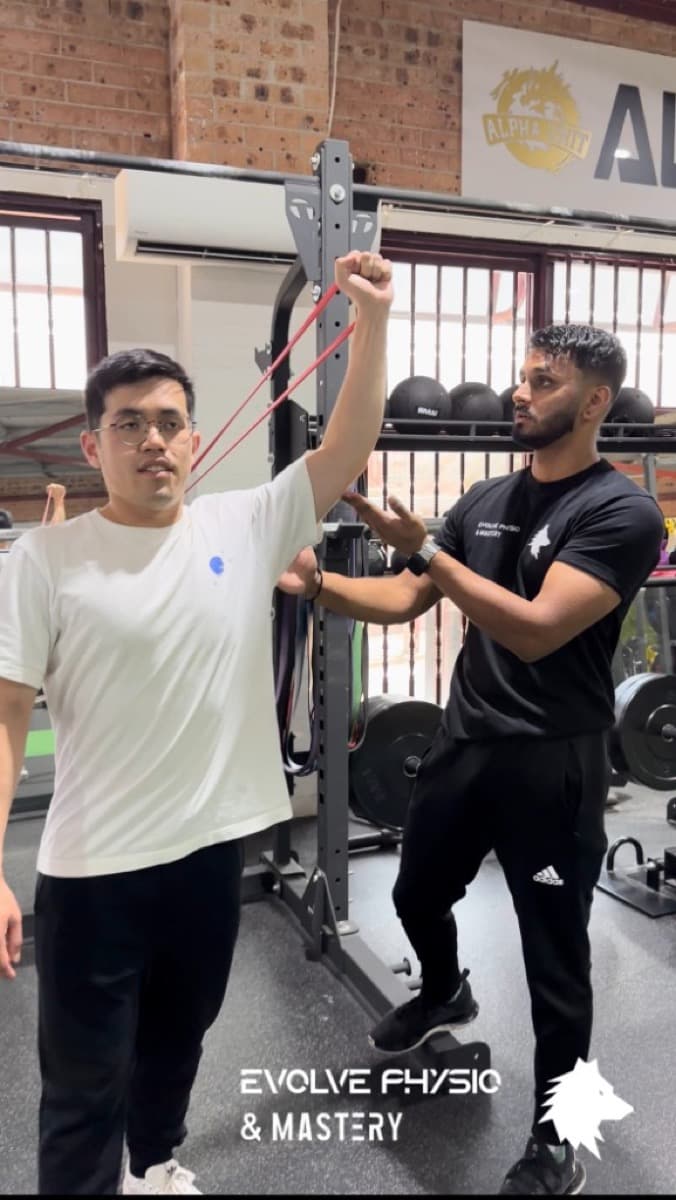
- External rotations — with band or light dumbbell, 3 sets of 12–15 per side. Builds rotator-cuff endurance.
- Prone scapular push-ups — 3 sets of 10. Serratus anterior endurance.
2. Micro-breaks and movement variability
Not "perfect posture" — varied posture. Every 30–45 minutes:
- Stand and walk 1–2 minutes
- 2–3 shoulder rolls, neck circles, and thoracic extension over the back of your chair
- Change between sitting and standing if you have a sit/stand desk
Motion is lubrication. Even brief interruptions to a static position reduce muscle fatigue significantly.
3. Ergonomic baseline
Not a cure, but it reduces the load you're asking the muscles to handle.
- Monitor at eye level — top of the screen at or just below your line of sight
- Forearms roughly parallel to the floor when typing
- Mouse close to the keyboard — avoid a long reach
- Feet flat on the floor or on a footrest
- Supportive chair with lumbar support
Cardio and overall strength matter too
People who do regular resistance training (2–3 times per week) and regular aerobic exercise report desk-related shoulder pain less often. The protective effect is robust across multiple studies. Think of it as building bigger "fuel tanks" for your postural muscles.
What to stop doing
- Obsessing over "perfect posture" — it doesn't exist; strong shoulders handle many positions
- Constant stretching without strengthening — short-term relief, no structural change
- Passive treatments only (massage, heat) as a long-term solution
- Ignoring the problem until it becomes a full-blown rotator-cuff or neck issue
When it's not just desk work
If your pain:
- Is severe, not just 3pm-aching
- Wakes you at night (see our sleep guide)
- Is associated with weakness, loss of range, or radiating arm pain
- Has persisted for more than 6 weeks of decent self-management
- Is climbing into your head as a mid-afternoon headache that starts at the base of the skull
- Has spread to your jaw — clicking, tightness, or aching by end of day, often from clenching while you concentrate
… it's time for a proper assessment. It may be early rotator cuff-related pain, frozen shoulder, or neck-referred pain rather than desk-endurance fatigue. If the upper-trap fatigue is now driving headaches, our cervicogenic headaches and migraines guide covers the assessment and treatment in detail. If the jaw is involved — clenching, clicking or tightness through the masseter — see the TMJ and jaw pain piece. Desk workers commonly have all three running together; addressing one in isolation usually leaves the other two to flare on a busy week.
Book a shoulder and upper-body assessment
If your desk job is quietly ruining your shoulders, a single session can set you up with a targeted 6-week program that changes the picture. Book a physio assessment at Evolve Physio & Mastery, and grab the Shoulder Mastery Guide for a structured home program you can run alongside work. We see clients from Liverpool, Cabramatta, Fairfield, Bankstown and across Southwest Sydney.
References: Richards et al. 2021 "Neck posture clusters and their association with biopsychosocial factors and neck pain in Australian adolescents" (Phys Ther); Mayer et al. 2012 "Job-related risk factors for rotator cuff syndrome" systematic review; Andersen et al. 2011 "Effectiveness of small daily amounts of progressive resistance training for frequent neck/shoulder pain" (Pain).
Frequently Asked Questions
Isn't desk-worker shoulder pain just bad posture?
The research has moved on from that narrative. Multiple large studies (including systematic reviews in the British Journal of Sports Medicine) have shown posture and shoulder pain correlate weakly at best. What matters more is endurance — the ability of your scapular and rotator-cuff muscles to hold position under low load for hours.
Should I get a standing desk?
It helps, but it's not a cure. Standing all day creates its own issues. The best evidence supports a sit/stand desk used dynamically — changing position every 30–60 minutes — rather than either extreme.
Why does it hurt only after 2–3 hours of work?
Because your postural muscles are running out of endurance. Low-level sustained contraction of the upper trapezius, levator scapulae and rotator cuff eventually produces muscle fatigue, metabolite accumulation, and pain. Breaks and targeted strength work directly reverse this.
What's the single most useful exercise?
If you could only do one: prone Ys or prone Ts — 3 sets of 10–15, 3–4 times per week. Builds endurance in the posterior rotator cuff and mid-trapezius, which directly offsets the forward-rounded shoulder position desks encourage.
Can ergonomics alone fix it?
Rarely, by itself. Good ergonomics reduce the load; targeted exercise builds capacity for the load that remains. You need both. Ergonomics without exercise tends to plateau; exercise without ergonomics tends to flare after long days.