Rotator Cuff Pain and Shoulder Impingement: When to See a Physio
Why shoulder pain is so common
The shoulder is the most mobile joint in the human body, and that mobility comes at a price: stability depends entirely on soft tissues — mainly the rotator cuff — rather than bony architecture. Overload those tissues (at work, in the gym, or through normal aging) and you get pain.
Rotator cuff and subacromial pain is one of the most common reasons people walk into our Cabramatta clinic. Our caseload spans Liverpool tradies with overhead work injuries, Bankstown CrossFitters with progressive loading errors, Fairfield office workers with posture-related issues, and people of all ages whose shoulders have simply been used a lot over decades.
What's actually wrong?
The old language — "impingement," "bursitis," "tendinitis" — has been replaced in the research literature by the umbrella term subacromial pain syndrome. It covers a spectrum that includes:
- Rotator cuff tendinopathy — irritated, overloaded supraspinatus (most common) or infraspinatus tendons
- Partial- or full-thickness rotator cuff tear — fibre-level damage, often degenerative in over-50s
- Subacromial bursitis — inflammation of the bursa that cushions the rotator cuff
- Long head of biceps tendinopathy — pain at the front of the shoulder
These conditions overlap, co-exist, and — importantly — respond to the same treatment.
Classic symptoms
- Pain reaching overhead or behind your back (e.g. putting on a seatbelt, reaching into the back seat)
- A painful arc between 60° and 120° of shoulder elevation
- Night pain — difficulty sleeping on the affected side
- Weakness in lifting moderate weights or carrying groceries
- Pain that started gradually with no clear single event (classic for tendinopathy)
Red flags — sudden loss of ability to lift the arm, significant trauma, constant pain at rest unrelated to position, or symptoms that wake you every single night despite position changes — warrant prompt medical review.
Why surgery usually isn't the answer
The 2018 CSAW trial (Beard et al., The Lancet) randomised 313 patients with subacromial pain to either arthroscopic decompression surgery, placebo (investigative arthroscopy only), or no treatment. Surgery was no better than placebo at 6 months or 1 year. The implications:
- The mechanical "removing the pinch" story has been overstated
- Pain comes from the tendon tissue itself, not the anatomy of the bone above it
- Exercise-based rehab targets the actual problem
Subsequent trials have compared exercise to surgery directly for rotator cuff tendinopathy and partial tears, and the results consistently favour conservative treatment as the first line. Surgery stays as an option for specific cases — not as the default.
What good rehab looks like
Three phases, 10–14 weeks in total:
- Phase 1 — settle the shoulder (weeks 1–3). Load management (modify overhead work, avoid provocative positions temporarily), isometric holds for the rotator cuff, scapular setting, and posture work. Hands-on therapy for short-term pain relief.
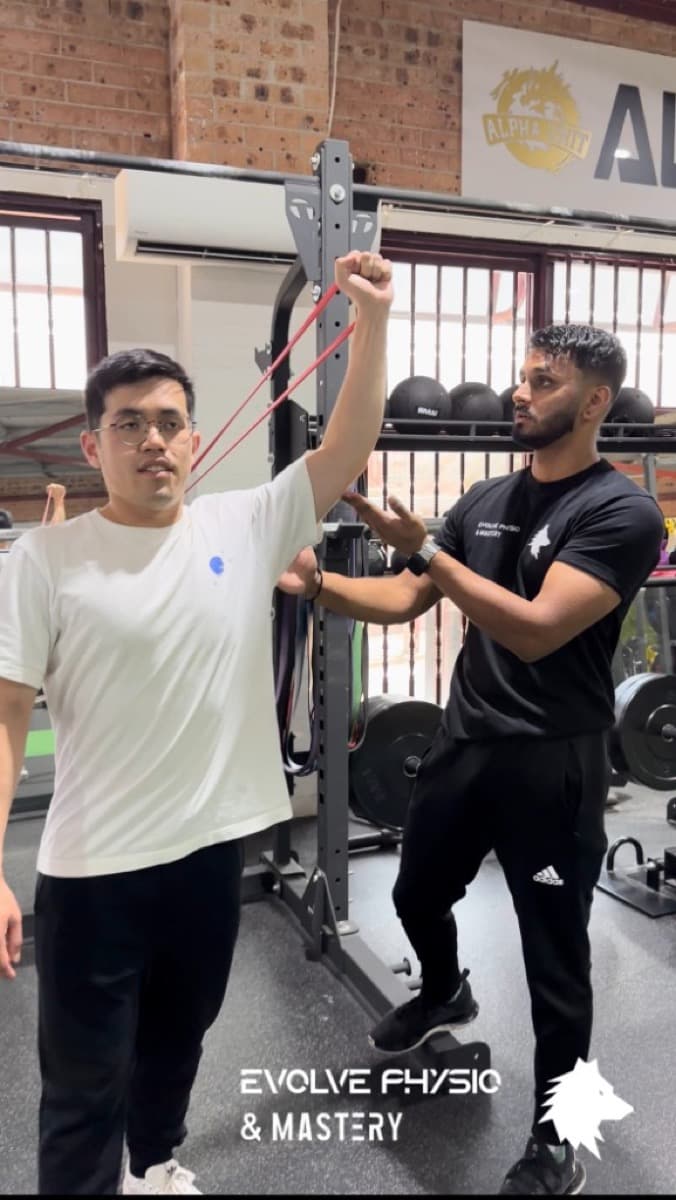
- Phase 2 — progressive loading (weeks 3–8). This is the main event. Heavy slow resistance training for the rotator cuff and scapular stabilisers. Exercises like external rotations, prone Ys and Ts, banded rows, and controlled overhead pressing as tolerance builds.
- Phase 3 — return to activity (weeks 8–14). Sport- and task-specific loading. For tradies, this means overhead drill/hammer/angle-grinder simulation. For swimmers, graded stroke volume. For gym-goers, progressive return to pressing and pulling.
What about injections?
Corticosteroid injections can give useful short-term pain relief in some cases, but the evidence shows they don't improve outcomes at 6–12 months compared with exercise alone. We use them selectively — usually only when pain is preventing someone from engaging with rehab.
What about posture and "text neck"?
Posture matters less than people think. Strong, adaptable shoulders handle a wide range of positions. Strength of the posterior rotator cuff and mid-back is a better predictor of durability than the exact angle of your shoulder blade. We work on strength, not postural perfection.
When we'd refer on
- Failure to progress with 8–12 weeks of good rehab
- Full-thickness rotator cuff tear in a younger, high-demand patient
- Suspicion of labral injury or shoulder instability
- Red-flag symptoms suggesting something outside musculoskeletal territory
At home: Mastery programs
Pair rehab with our free Shoulder Mastery Guide — the same style of work we use for impingement and cuff-related pain — plus the Back and Knee Mastery guides if your chain isn't only the shoulder. All programs.
Book a shoulder assessment
If you're dealing with shoulder pain that won't settle — whether you're a tradie with overhead work in Liverpool, a gym-goer in Cabramatta, or you simply can't sleep on your side — a proper physio assessment usually reveals a clear pathway forward. Book a shoulder physio assessment at Evolve Physio & Mastery. We see clients across Liverpool, Cabramatta, Fairfield, Bankstown and Southwest Sydney.
References: Beard et al. 2018 "Arthroscopic subacromial decompression for subacromial shoulder pain (CSAW): a multicentre, pragmatic, parallel group, placebo-controlled, three-group, randomised surgical trial" (Lancet); Kuhn et al. 2013 (MOON Shoulder Group); Lewis 2016 "Rotator cuff related shoulder pain" (Br J Sports Med).
Frequently Asked Questions
Do I need a scan before starting rotator cuff rehab?
For most cases, no. Ultrasound or MRI scans of healthy shoulders over 50 routinely show 'abnormalities' — partial-thickness tears, bursitis, and tendinopathy — in people with no pain at all. Imaging is reserved for true red flags (significant trauma, suspected full-thickness tear in a young patient, or failure to progress with 8–12 weeks of good rehab).
What's the difference between impingement, tendinopathy, and a tear?
All overlap. 'Subacromial pain syndrome' is now the preferred umbrella term. Impingement describes a mechanism; tendinopathy describes tendon tissue that's become irritated by overload; a tear describes actual fibre damage. They often co-exist and respond to the same exercise-based treatment — which is why the label matters less than you might think.
Is surgery ever needed?
Sometimes — full-thickness traumatic tears in younger patients, massive irreparable tears with functional loss, or failed conservative treatment over 6+ months. For the overwhelming majority of subacromial pain, high-quality evidence (Beard et al. 2018, Lancet) shows exercise-based physiotherapy produces outcomes equal to arthroscopic decompression surgery.
How long will rehab take?
Most people see meaningful improvement within 6–8 weeks of consistent rehab, with near-full recovery at 12–16 weeks. Tendinopathy is slower to change than muscle strain — expect 3 months of patient, progressive loading, not 3 weeks of quick fixes.
Why does my shoulder hurt most at night?
Night pain is classic for rotator cuff / subacromial issues. Lying on the shoulder compresses the bursa; lying on the opposite side lets the arm fall and stretch the irritated structures. A pillow under the affected arm, hugged to your chest, usually helps.