Shoulder Dislocation Rehab: Why the First One Sets Up the Next Ten
Why first-time dislocations are a turning point
The shoulder is the most mobile joint in the body, and mobility comes at the cost of stability. When it dislocates — almost always anteriorly, meaning the humeral head slips forward out of the socket — several structures can be damaged: the labrum (often a Bankart lesion), the capsule, the glenoid bone, and sometimes the rotator cuff. What happens in the next three months determines whether this becomes a single event or a recurring problem.
We see shoulder dislocations across our Liverpool and Cabramatta catchment in young rugby league and AFL players, martial artists, gym-goers, and older adults after falls. Each group has slightly different priorities, but the core rehab framework is the same.
The first 72 hours
- Get the shoulder reduced (put back in) — this happens at A&E or occasionally pitchside by an experienced clinician.
- Imaging to rule out bony injury (X-ray is standard; MRI is added if symptoms persist or imaging suggests soft-tissue damage).
- Sling for comfort — for 1–3 weeks depending on severity and surgeon preference. Longer is not better.
- Start gentle pendulum exercises and submaximal isometrics early to prevent stiffness.
Weeks 1–3 — protect and settle
Goals: pain control, restoring comfort, and early activation. We avoid the "apprehension" position (abduction + external rotation) but introduce:
- Pendulum exercises
- Isometric internal and external rotation (arm by side)
- Scapular setting
- Passive/assisted forward flexion within comfort
Weeks 3–8 — build the foundation
Goals: restore range of motion, start strengthening the rotator cuff and scapular muscles, and begin proprioceptive re-education.
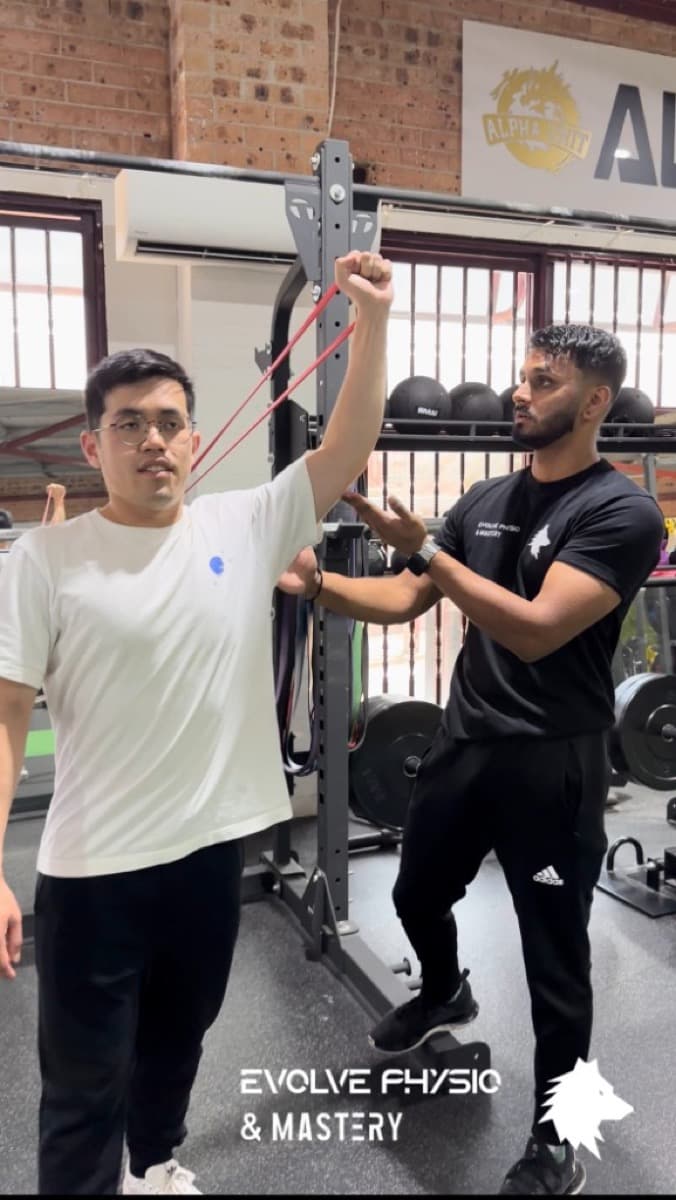
- Band-resisted external and internal rotation, progressing load weekly
- Prone Ys, Ts and Ws for posterior rotator cuff and mid-trapezius
- Scapular push-ups and serratus anterior work
- Controlled overhead reaching when pain allows
- Careful avoidance of the max-apprehension position until strength returns
Weeks 8–12 — dynamic stability
This is where we start building genuine stability under load.
- Closed-chain work (wall push-ups progressing to floor push-ups, banded planks)
- Dumbbell pressing and rowing, progressing load
- Rhythmic stabilisation drills (the physio or a partner applies unpredictable perturbations)
- Sport-specific movement — gradual introduction of contact, throwing, swimming, or overhead lifts
Weeks 12+ — sport-specific return
Criteria-based — not time-based — return to sport. We check:
- External-rotation strength ≥90% of the uninjured side
- Full pain-free range of motion
- Confidence in the apprehension position
- Completion of a graduated sport-specific program (tackling drills for contact, overhead throwing volume for throwers, etc.)
The surgery question
Primary surgical stabilisation — usually an arthroscopic Bankart repair — significantly lowers recurrence rates in high-risk groups. The Canadian MOON Shoulder Group and other large cohorts have shown:
- Under-20 contact athletes: non-operative recurrence rates 70–90% → strong case for early surgery
- 20–30 year olds in collision sports: meaningful recurrence reduction with surgery
- Over 40s: recurrence less common, but rotator-cuff tears are more frequent — the conversation shifts
We don't make this call alone. We'd refer to an orthopaedic surgeon and rehabilitate alongside — whichever pathway you choose.
How it connects to the broader picture
If your dislocation was associated with a labral tear on MRI, our labral tear guide covers that territory. For non-dislocation shoulder pain, see our rotator cuff guide and frozen shoulder guide.
Book a shoulder instability assessment
If you've had a first-time dislocation, a recurrence, or a "dead arm" episode during sport, don't leave the rehab to chance. Book a shoulder physio assessment at Evolve Physio & Mastery. Pair it with our Shoulder Mastery Guide for a structured home program. We see clients from Liverpool, Cabramatta, Fairfield, Bankstown and across Southwest Sydney.
References: Hovelius et al. 2008 "Primary anterior dislocation of the shoulder in young patients: a ten-year prospective study"; Olds et al. 2015 systematic review on recurrent instability; Brophy & Marx 2009 "Osteoarthritis following shoulder instability"; MOON Shoulder Group cohort studies.
Frequently Asked Questions
After a dislocation, how long should I be in a sling?
Current evidence suggests 1–3 weeks of sling immobilisation is sufficient — longer is not better and can lead to stiffness. External-rotation bracing was once thought to reduce recurrence but larger trials haven't confirmed a meaningful advantage.
What's the actual risk of dislocating it again?
It depends hugely on age and sport. In under-20 contact athletes, recurrence rates after first-time anterior dislocation managed non-operatively are as high as 70–90%. In adults over 40, recurrence is less common but rotator-cuff tears are more likely. Primary surgical stabilisation is offered in higher-risk groups to reduce recurrence.
Can I play sport again after a dislocation?
Yes — most people do. The critical pieces are a criterion-based return-to-sport process (strength, stability, sport-specific drills, confidence) and, in some cases, a decision about early surgery. Timelines typically range from 3 months for non-contact sport to 4–6 months for contact sport.
Will I know if I've dislocated or just 'subluxed' my shoulder?
A true dislocation usually requires reduction (often at A&E). A subluxation — where the shoulder slips out and back in — can feel like a momentary 'dead arm' or a deep catch. Either counts as shoulder instability and both benefit from the same rehab approach.
Do I need surgery if I've dislocated my shoulder more than once?
If you've had recurrent dislocations or subluxations, surgical stabilisation (most commonly Bankart repair) has strong evidence for reducing future events. We'd refer you to an orthopaedic surgeon and rehabilitate before and after.