Shin Splints (Medial Tibial Stress Syndrome): What Runners Get Wrong
Why shin splints are so misunderstood
Runners get two pieces of advice when their shins start hurting: "rest" or "push through." Neither works particularly well. Rest alone doesn't build the tissue capacity to handle running; pushing through turns a niggle into a stress fracture. The right approach is somewhere in the middle, and it's specific enough that most runners need a plan.
We see medial tibial stress syndrome (MTSS) constantly in our Liverpool and Cabramatta catchment — mostly in people who've recently increased weekly mileage, signed up for a half marathon, or picked up running during Daylight Saving. It's extremely treatable, but only if you stop treating it like a simple rest-problem.
What's actually going on
MTSS sits on a spectrum of bone stress injury. At the mild end, it's a remodelling response — the tibia is being loaded faster than it can adapt, and you get diffuse tenderness along the inner edge of the shin. At the severe end, it becomes a stress fracture with focal pain and potential for prolonged time off running.
Key factors that push you along the spectrum:
- Too much running volume too quickly
- Inadequate calf / foot strength for current load
- Hard running surfaces (concrete) with insufficient adaptation
- Sudden changes in running shoes or style
- Low energy availability (under-fuelling, disordered eating)
- Low Vitamin D and iron status
How we assess it
- Palpation along the medial tibial border — the pattern of tenderness tells us a lot
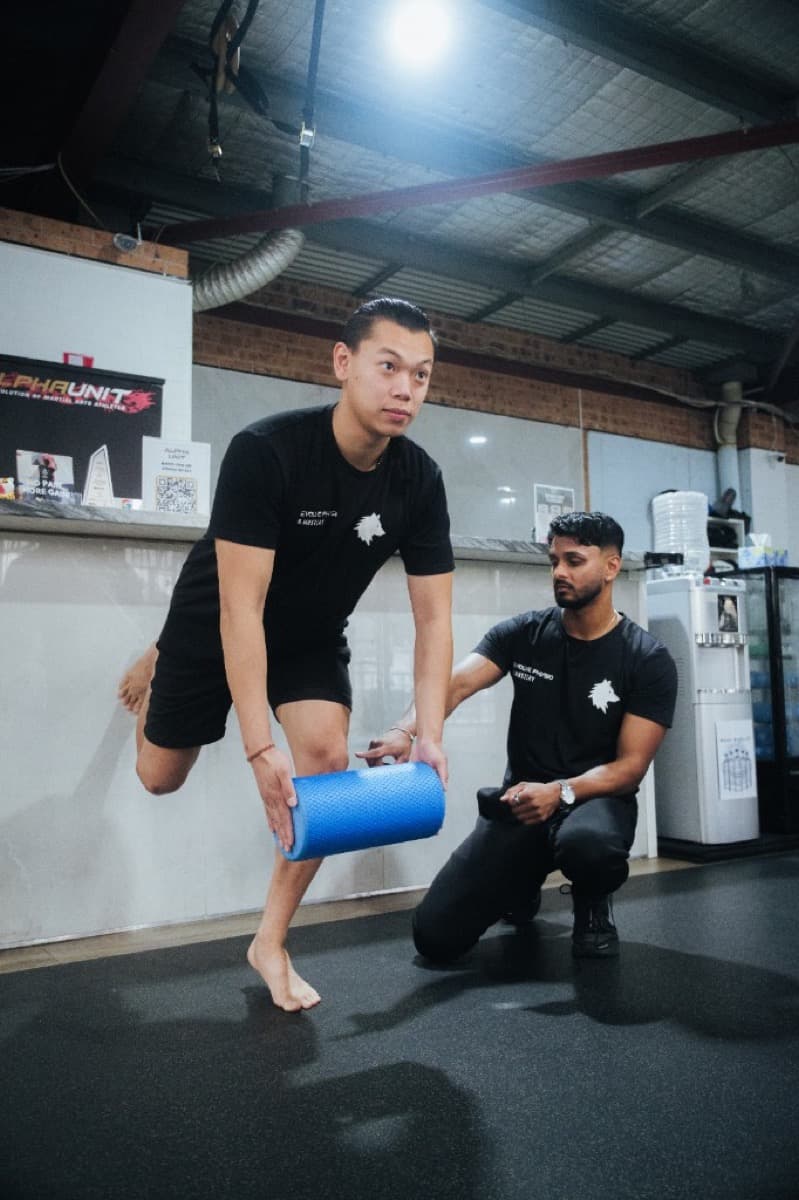
- Hop test — single-leg hops on the affected leg. Sharp, focal pain is a red flag for stress fracture
- Calf endurance test — single-leg calf raises to failure. Most shin-splint runners manage fewer than 20 per side; we want 30+
- Training-load review — this is where the diagnosis usually becomes obvious
- Imaging only for suspected stress fracture (MRI is the gold standard)
What actually fixes it — the load-and-capacity approach
Step 1: Reduce load (don't eliminate it)
Most runners benefit from a 30–50% reduction in weekly running volume for 2–4 weeks. Complete rest deconditions the tibia further and sets you up for another flare. During this window, cross-train — swimming, cycling, rowing, elliptical — at comparable effort.
Step 2: Build calf capacity
This is the single most under-done intervention.
- Heavy slow calf raises — both straight-leg (gastrocnemius) and bent-knee (soleus). 3 sets of 6–8 reps with a heavy backpack, every second day.
- Single-leg calf endurance — to failure, then repeat 2–3 times. Build toward 30+ per side.
- Foot intrinsics — short-foot exercise, towel scrunches, toe yoga.
Step 3: Progressive return to running
A walk-run protocol for 2–4 weeks, then progressive volume. Classic structure:
- Week 1–2: 1 min run / 2 min walk × 6–8, three times per week
- Week 3–4: 3 min run / 1 min walk × 5–6, three times per week
- Week 5–6: 5 min run / 1 min walk × 4–5, three times per week
- Week 7+: continuous running, progressing weekly volume by no more than 10–15%
Step 4: Look at the whole runner
- Fuelling adequate for training volume
- Sleep — a major determinant of bone remodelling
- Hip and glute strength (often the upstream driver of tibial overload)
- Appropriate footwear — not necessarily "best" shoes, but shoes you've adapted to
Stress fracture — when to escalate
Red flags for suspected stress fracture:
- Sharply focal tenderness (a 1–2cm spot rather than diffuse along the shin)
- Night pain at rest
- Hop test produces sharp local pain
- History of disordered eating, menstrual irregularities (relative energy deficiency in sport / REDs)
- Prior stress fracture
We'd organise imaging and a short period off-running if suspicion is high.
How it fits into our running content
For ITB pain, see our ITB syndrome guide. For anterior knee pain, our runner's knee guide. For coming back from any layoff, our return to running guide. For the stress fracture end of the spectrum, see our stress fractures guide.
Watch the full framework in action
We've broken down the 20-week running durability framework we use with our own athletes — including how we address old injuries, mechanics and tendon health — in The Best Running Protocol Nobody Teaches. If you're coming back from shin splints and want to do it properly, start there.
If knee or ACL history is complicating your return to running, our ACL Comeback Program covers the strength-and-plyometric side of the rebuild. Everyone else should layer in the free Knee Pain Mastery Guide for structured leg work between runs. All programs.
Book a running assessment
If shins are holding back your training, a one-hour assessment will map out exactly what to change. Book a running physio assessment at Evolve Physio & Mastery. We see runners across Liverpool, Cabramatta, Fairfield, Bankstown and Southwest Sydney.
References: Moen et al. 2009 "Medial tibial stress syndrome: a critical review" (Sports Med); Winters et al. 2018 randomised trial of graded running programs for MTSS; Warden et al. 2021 "Management of bone stress injuries in the athletic population" (Br J Sports Med).
Frequently Asked Questions
What exactly are shin splints?
Medial tibial stress syndrome (MTSS) — pain along the inside edge of the shin bone caused by repetitive loading of the tibia and surrounding tissues faster than they can adapt. It sits on a continuum between 'mild bone stress' and full-blown stress fracture.
Should I run through it?
Usually no. Pain during running that persists and worsens week-over-week is a signal to pull the load back temporarily — not stop entirely. Continuing to push volume at the same level is what turns a minor bone stress reaction into a stress fracture.
How is it different from a stress fracture?
They're on the same spectrum. MTSS is diffuse tenderness along a 5cm+ strip of the shin; stress fracture is focal, usually hop-painful, and may show on MRI. If your pain is sharply localised, worsens with hopping, or is disturbing your sleep, we'd be suspicious of a stress fracture and escalate imaging.
Do custom orthotics fix shin splints?
Rarely by themselves. Evidence for custom orthotics is modest at best. Load management, calf/foot strength, and a sensible training progression matter far more.
How long will it take to fully recover?
Typical uncomplicated cases take 6–8 weeks of modified running plus strength work. Complex or recurrent cases can take 3–4 months. If it's been more than 2–3 weeks of ignoring it, the recovery timeline generally doubles.