Shoulder Pain on Overhead Press: When to Keep Lifting (and How)
Free program
The Shoulder Mastery Guide
MMA Rehab Guide for Shoulder Dislocations!
The press is a test, not a personality trait
Overhead press lights up a lot of shoulders in Southwest Sydney gyms — not because pressing is evil, but because people jump from a desk week to a 5×5 they have not earned. Pain at the top of the lift, a pinch on the way up, or a dull ache that night is the cuff and scapula telling you the angle and the load do not match current capacity.
What we see under the bar
- Rib flare and lumbar dump so the bar “gets up” without thoracic extension.
- Elbows too wide, so the cuff works as a brake instead of a centre-er.
- No pull work. Lots of bench. The front of the shoulder wins every week.
- A recent spike — new program, new coach, or “I used to press this in 2019.”
Desk posture is the other half. If that is you, read desk-worker shoulder as well. Swimmers and fighters have their own versions — swimming injuries, pad-work shoulder.
How we keep you in the gym
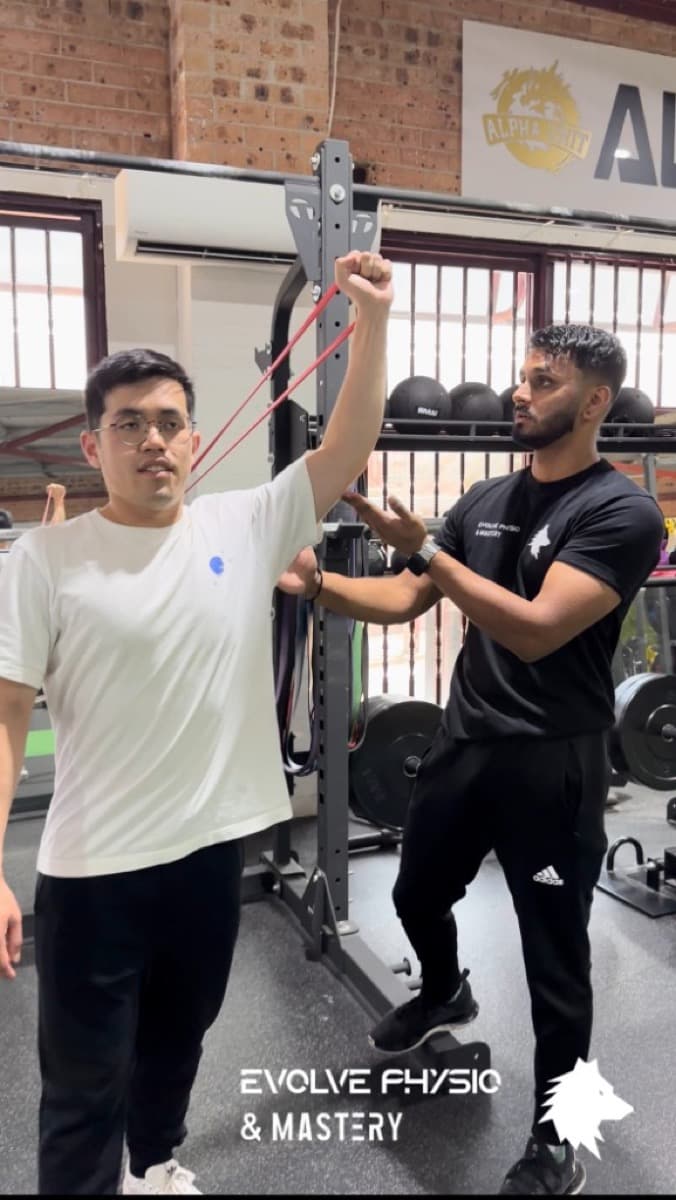
We do not put a “no lifting” sticker on your forehead. We find a press variation that does not swell or steal sleep (landmine, half-kneeling, shorter range), load the cuff on purpose, restore thoracic extension, and rebuild the full overhead as a skill. Behind-the-back reach is a useful check — if that is gone too, see reaching behind your back.
Red flags in the weights room
A pop with immediate weakness, a shoulder that will not stay in, fever, or unexplained weight loss is not a “deload week.” Get assessed. History of dislocation changes the plan.
Guide + book
Free structure: Shoulder Mastery Guide. Want it mapped to your program? Book a gym-shoulder assessment at Evolve Physio & Mastery, Cabramatta — Liverpool, Fairfield, Bankstown and the Southwest.
Frequently Asked Questions
Should I stop all pressing?
Usually no. We drop the painful end range and the heaviest sets, then keep horizontal and supported pressing the joint can clear in 24 hours. Total rest deconditions the cuff you need to press again.
Is this impingement?
“Impingement” is a mechanism, not a full diagnosis. The useful question is whether the cuff and scapula can control the head of the humerus at the angle you are loading. See our <a href="/blog/rotator-cuff-shoulder-impingement-physio">rotator cuff guide</a>.
Can I still bench?
Often yes, with a shorter range, more control, and less flare-up the next day. Wide, bounced, high-volume bench is a common irritant. We test it rather than banning the gym.
Do I need an injection to keep training?
Not first-line. Injections can have a place after a failed loading program or for a frozen, highly irritable joint. They are not a substitute for getting the press pattern and cuff capacity in order.
How long until I overhead again?
Many gym-goers return to a working press in 4–8 weeks if they stop living at the painful end range and actually train the cuff. A true tear, dislocation or frozen shoulder is a longer calendar.
Is there a free program?
Yes — the Shoulder Mastery Guide. If this started after a dislocation or you have a dead-arm feeling, book in rather than only using the PDF.