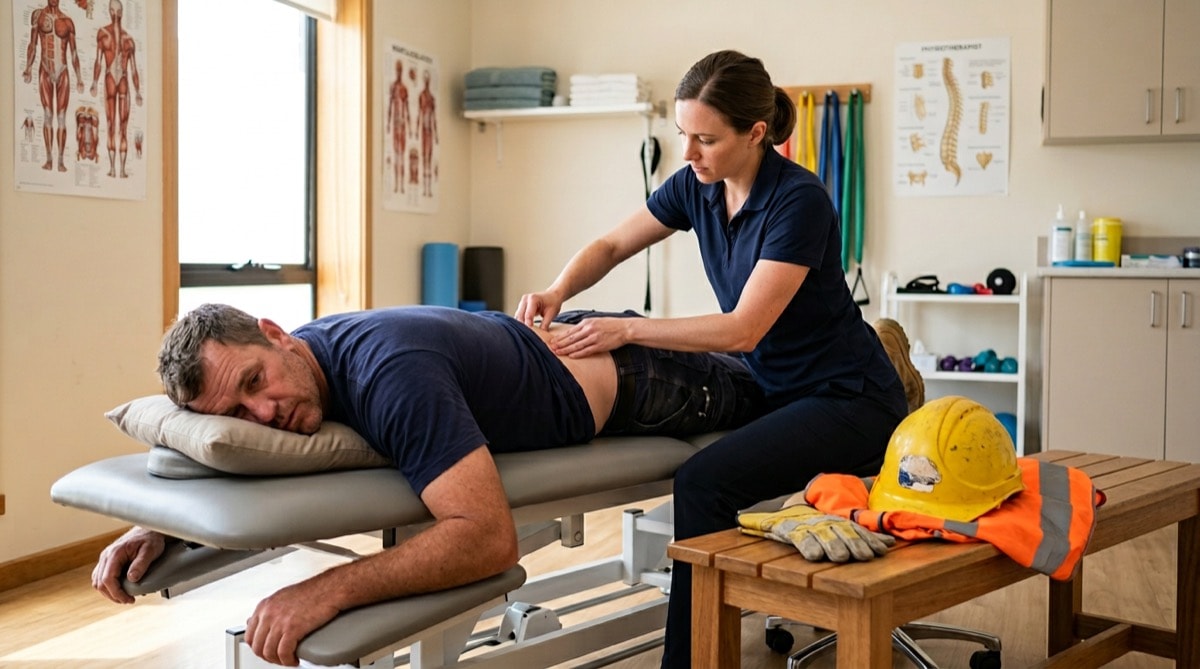
Suitable Duties on WorkCover NSW: How Return to Work Actually Gets Built
Free program
The Workers Compensation Mastery Guide
Navigating a work-related injury can feel overwhelming. Between paperwork, insurers, case managers, and recovery expectations, it's easy to feel unsure about what to do next. Our Workers Compensation Guide is designed to simplify the process and give you clarity at every stage.
Light duties is not a personality test
On a NSW workers compensation claim, “suitable duties” are the bridge between being too sore to do your normal job and being safely back at it. They are supposed to be specific, time-limited, and upgraded as you improve. What we see too often in Southwest Sydney is the opposite: no plan, a shrug that “there’s nothing light,” or a full-time return that blows the injury up in week two.
This post is educational, not legal or financial advice. For scheme rules see SIRA NSW and icare. For legal questions, see a workers compensation lawyer.
The certificate is the rulebook
Your Certificate of Capacity sets hours, lifting limits, postures, and travel. Suitable duties have to fit that document. If the certificate says no lifting over 5 kg and the “light” job is still moving 15 kg boxes, that is not suitable — it is the old job with a new label.
Physio’s job is to make the certificate honest. We test what you can actually do, then talk to your GP so restrictions shrink as capacity grows. A certificate that never changes is usually a recovery that has stalled — or a workplace that has stopped offering upgrades.
What a decent plan looks like
- Written. Hours, tasks, review date.
- Task-specific. “No overhead, no ladders, sit-stand every 30 minutes” beats “light duties.”
- Time-bound. Review in 1–2 weeks, not “until further notice” for six months.
- Progressive. Hours or load increase when the joint or back is coping, not because the roster is short.
- Supervised. Someone on site knows the restrictions. A plan nobody on the floor has seen will fail on the first busy shift.
When the workplace says no
Some jobs really are all-or-nothing (certain labouring, some driving, some care work). Then the options are reduced hours, a different site, a temporary role, or staying off until capacity matches the real job. That is a conversation between you, the GP, the insurer and the employer — not a decision you should have to invent in the lunch room.
If you are a cleaner, tradie, nurse, or warehouse worker, the modifications look different. See our occupation posts: cleaners, tradies, nurses, warehouse.
How physio fits
We treat the injury and we rehearse the job: lift patterns, overhead tolerance, sitting blocks, grip endurance. Treatment that never looks like your work is why people “feel better in the clinic” and flare on Monday.
Guide + book
Walk the NSW pathway in our free Workers Compensation Mastery Guide. Need treatment on a claim? Book WorkCover physio in Cabramatta — we liaise with GPs and insurers for clients from Liverpool, Fairfield and Bankstown.
Related: WorkCover physio overview · first 48 hours.
Frequently Asked Questions
What are suitable duties?
Work your employer can reasonably provide that fits the medical restrictions on your Certificate of Capacity — hours, loads, postures, and tasks. They are meant to be temporary and progressive, not a permanent demotion.
My boss says there are no light duties. Is that the end?
Not automatically. Many workplaces have more flexibility than they first admit (shorter shifts, no overhead, no ladders, admin blocks, buddy-lifts). If genuinely nothing exists, the insurer and a return-to-work coordinator get involved. This is not legal advice — a workers compensation lawyer can advise if the workplace is not engaging.
Do I have to accept any duty they offer?
You are generally expected to participate in reasonable return-to-work. You are not expected to do tasks that breach your certificate. If a task clearly exceeds the restriction, say so and have your GP or physio document it.
Who writes the return-to-work plan?
Usually the employer or their return-to-work coordinator, using the Certificate of Capacity and input from you, the GP, the insurer, and treating physio. You should see the plan in writing.
Can physio decide my hours?
Your GP owns the Certificate of Capacity. Your physio feeds function — what you can lift, sit, stand, and repeat — so the certificate matches real capacity instead of a guess.
Is this legal advice?
No. This is general educational information about how we see return-to-work work in clinic. For legal questions, speak to a workers compensation lawyer. Scheme rules: SIRA NSW and icare.