Zero to Half Marathon: A 16-Week Running Prep Plan (km, Phases & Red Flags)
Video masterclass
The Best Running Protocol Nobody Teaches | Ultra Marathon Prep
The full 20-week framework we use to prep runners for marathons and ultras — addressing old injuries, mechanics, tendon health, and durability. Watch the full session below — then open the video page for notes, timestamps, and related guides.
Mastery program
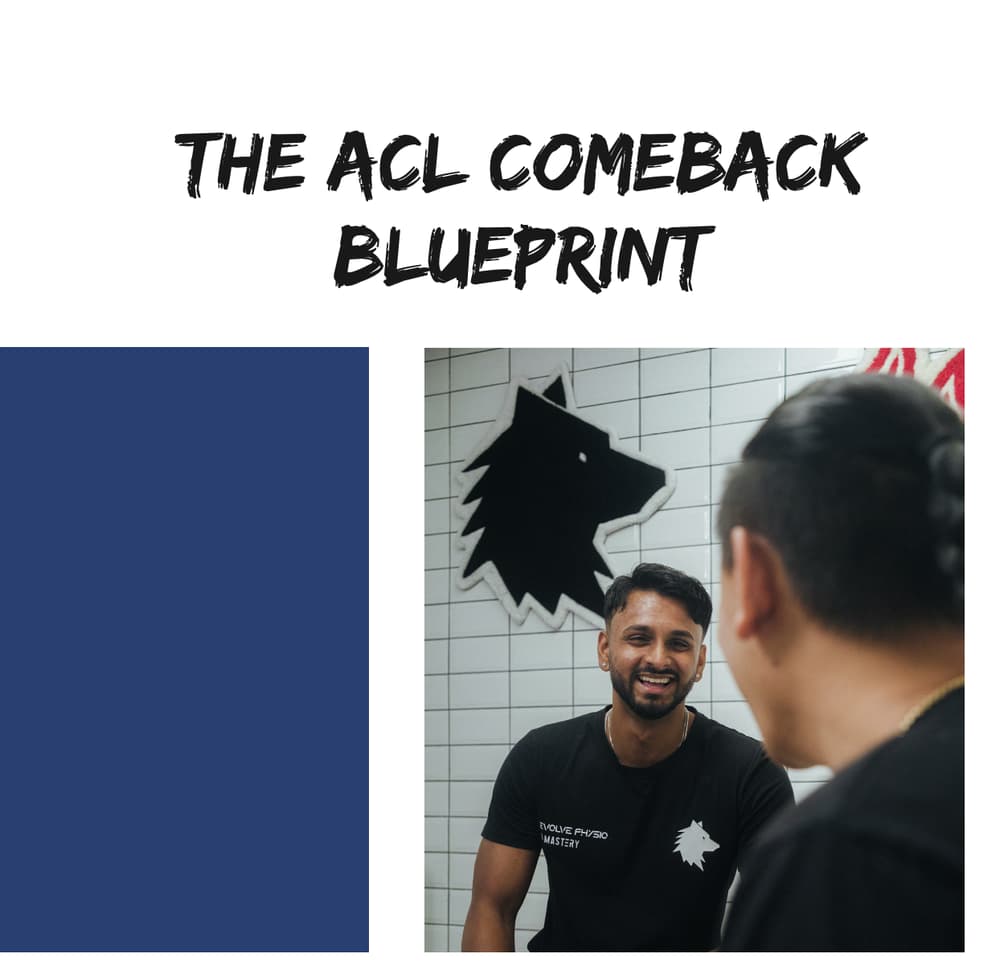
The ACL Comeback Program
A structured 28-day knee rehab program designed for people stuck in the "almost better" phase after ACL or meniscus injury. Rebuild strength, restore confidence, and bridge the gap between feeling okay and being fully back.
From the couch to 21.1 km — without breaking down
A half marathon is 21.1 kilometres. From a standing start, that is a realistic goal for most healthy adults — but only if connective tissue (tendons, bone, plantar fascia) gets as much runway as your lungs. Aerobic fitness adapts in weeks; bone and tendon need months of progressive load. That is why this plan is 16 weeks, not a rushed 8-week crash course.
This is the week-by-week schedule we use as a template with first-time half marathoners in Cabramatta and Southwest Sydney. For the deeper mechanics, tendon conditioning and 20-week durability framework, watch our Running Masterclass. If you are coming back from ACL or knee surgery, start with the ACL Comeback Program before you chase race volume.
Who this plan is for
- You currently run little or nothing, but can walk briskly for 30+ minutes
- You have (or will pick) a half marathon ~16 weeks away
- You can commit to 3 run days + 2 short strength sessions most weeks
- You are cleared for progressive exercise (see GP/physio first if you have chest pain, uncontrolled medical conditions, recent fracture, or unstable knee/ACL history)
Already running 5 km continuously 3×/week? You can enter at Week 5. Coming back from injury? Use our 8-week return-to-running framework first, then join this plan when hop and jog criteria are cleared.
How the plan is built (loading rules)
- 3-up, 1-back: build volume for ~3 weeks, then a lighter “step-back” week so tissues adapt
- ~10% rule: weekly km usually rises by ≤10% (step-backs intentionally drop)
- Long run ≤ ~35% of that week’s total running volume
- Easy means easy: ~80% of runs at conversational effort (RPE 3–4/10)
- Walk–run is allowed — especially Weeks 1–4 and on race day if needed
- Strength is not optional — 2×/week cuts running injury risk substantially in the research
The four loading phases
Phase 1 — Foundation (Weeks 1–4)
Build the habit. Walk–run intervals. Low total km. Teach calves, Achilles and plantar fascia to tolerate impact. Goal by end of week 4: complete a comfortable ~5 km outing (run–walk OK).
Phase 2 — Build (Weeks 5–9)
Shift toward continuous easy running. Long run climbs into the 7–10 km range. Still almost all easy pace — no hero intervals.
Phase 3 — Peak (Weeks 10–13)
Highest weekly volume. Longest long run peaks at 16 km in week 13. Optional short “strides” (6–8 × 20 sec smooth pickups) once per week after an easy run if form feels solid.
Phase 4 — Taper & race (Weeks 14–16)
Cut volume so you arrive fresh. Keep a little frequency so legs stay sharp. Race week is short and boring on purpose.
Weekly template
- Tue — Easy run (or walk–run)
- Wed — Strength A (20–30 min) or rest if very sore
- Thu — Easy run
- Fri — Strength B or full rest
- Sat — Rest or easy walk
- Sun — Long run (most important session)
- Mon — Rest
Swap days to fit life — keep at least one full rest day and avoid stacking the long run next to a hard strength day.
16-week schedule (km + estimated time)
Times assume a beginner conversational pace of roughly 7:00–7:30/km including walk breaks early on. Slower or faster is fine — hit the distance (or total time-on-feet) without gasping.
WR = walk–run (e.g. 2 min jog / 1 min walk). Easy = continuous jog if you can; insert walks before form falls apart.
Phase 1 — Foundation
- Week 1 — Tue WR 2 km (~20 min) · Thu WR 2 km (~20 min) · Sun Long WR 3 km (~25–30 min) · Total ~7 km / ~65–70 min
- Week 2 — Tue 2.5 km · Thu 2.5 km · Sun 4 km · Total ~9 km / ~70–80 min
- Week 3 — Tue 3 km · Thu 3 km · Sun 5 km · Total ~11 km / ~80–90 min
- Week 4 (step-back) — Tue 2.5 km · Thu 2.5 km · Sun 5 km “practice race” or parkrun · Total ~10 km / ~75–85 min
Watch for: calf tightness that worsens day-to-day, shin ache that lingers next morning, blisters from new shoes. Shoe tip: get fitted early; nothing brand-new on race week.
Phase 2 — Build
- Week 5 — Tue Easy 3 km · Thu Easy 3.5 km · Sun Long 6 km · Total ~12.5 km / ~90–100 min
- Week 6 — Tue 3.5 km · Thu 4 km · Sun 7 km · Total ~14.5 km / ~100–115 min
- Week 7 — Tue 4 km · Thu 4 km · Sun 8 km · Total ~16 km / ~110–125 min
- Week 8 (step-back) — Tue 3.5 km · Thu 4 km · Sun 6.5 km · Total ~14 km / ~100–110 min
- Week 9 — Tue 4 km · Thu 5 km · Sun 9–10 km · Total ~18–19 km / ~125–145 min
Watch for: runner’s knee (front of knee), ITB lateral knee pain, early plantar heel pain. If knee history or ACL rehab is in the picture, keep strength sessions non-negotiable and stay inside the ACL Comeback criteria before adding speed.
Phase 3 — Peak
- Week 10 — Tue 5 km · Thu 5 km · Sun Long 11 km · Total ~21 km / ~145–160 min
- Week 11 — Tue 5 km · Thu 5.5 km · Sun 12–13 km · Total ~22.5–23.5 km / ~160–175 min
- Week 12 (step-back) — Tue 4.5 km · Thu 5 km · Sun 10 km · Total ~19.5 km / ~140–155 min
- Week 13 (peak) — Tue 5 km · Thu 6 km (+ optional strides) · Sun Long 16 km · Total ~27 km / ~190–210 min
Watch for: bone-stress signals (localised shin/foot pain, hop pain), Achilles morning stiffness that doesn’t warm up, sleep debt, and under-fueling. Peak weeks are when most first-timers get greedy — do not add “bonus” long runs.
Phase 4 — Taper & race
- Week 14 — Tue 4 km · Thu 5 km · Sun 12 km · Total ~21 km / ~145–160 min
- Week 15 — Tue 4 km · Thu 4 km · Sun 8 km · Total ~16 km / ~110–120 min
- Week 16 (race week) — Tue Easy 3 km · Thu Easy 2–3 km with 4 short strides · Fri–Sat rest · Sun HALF MARATHON 21.1 km · midweek volume ~5–6 km before race day
Race day: start slower than ego suggests for the first 3–5 km. Planned walk breaks (e.g. 15–30 sec each aid station) are smart strategy, not failure.
Strength sessions (2× per week, 20–30 min)
Do these on non-long-run days. Reduce heavy lifting in weeks 15–16.
- Single-leg calf raises (straight knee): 3 × 8–12 / side
- Bent-knee calf raises or seated calf: 3 × 10–12
- Split squat or step-up: 3 × 8 / side
- Hip hinge / single-leg RDL: 3 × 8 / side
- Side plank or Copenhagen adductor: 3 × 20–30 sec
- Dead bug or pallof press: 3 × 8–10
Full lower-limb durability context lives in the Running Masterclass. General knee loading between runs: free Knee Pain Mastery Guide.
Fueling & recovery basics
- Before: small carb snack 45–60 min pre-run once sessions exceed ~45 min
- During: practice fueling on long runs over ~75–90 min — roughly 30–60 g carbohydrate/hour; sip fluid, add electrolytes in heat
- After: protein + carbs within ~45 min; sleep 7–9 hours
- Never try a new gel, shoe, or breakfast on race day
Things to look out for (red flags)
- Stop and assess: pain that worsens as you run, forces a limp, or is still there next morning
- Stress fracture screen: pinpoint bone pain (shin, midfoot, femur) worse with hopping — see stress fractures in runners
- Achilles / calf: morning stiffness + pain that warms then returns — don’t “run through” sudden calf grabs (calf strain guide)
- Knee: front-of-knee load pain → runner’s knee; lateral knee → ITB syndrome
- Shins: diffuse medial shin ache after mileage jumps → shin splints guide
- Systemic: unusual SOB, chest pain, dizziness, or black stools — medical care, not more mileage
Missed a week to illness? Do not “make up” kilometres. Resume at the last comfortable week or repeat a step-back week. Finishing healthy beats a PB on a broken leg — same message as our marathon load-management guide.
ACL history? Don’t skip the strength bridge
Post-ACL runners often look fine on flat easy jogs and then flare when volume or hills arrive. Criterion-based strength, hop symmetry and confidence matter more than the calendar. Use the ACL Comeback Program for that 28-day rebuild, read ACL return-to-sport testing, then layer this half-marathon plan on top — not the other way around.
Go deeper: Running Masterclass
This article is the practical 16-week couch-to-half schedule. For the full workshop-style breakdown we use with marathon and ultra athletes — mechanics, deceleration, tendon capacity and long-block periodisation — watch The Best Running Protocol Nobody Teaches (Running Masterclass) in our video library.
Book a running prep screen
A single pre-block assessment catches calf capacity, hop asymmetry and bone-stress risk before week 10 of a plan. Book a running physio assessment at Evolve Physio & Mastery, Cabramatta. We help first-time half marathoners across Liverpool, Fairfield, Bankstown and Southwest Sydney.
Related reading: return to running after injury · marathon & half injury prevention · ACL Comeback Program · Running Masterclass.
References: Gabbett 2016 training-injury prevention paradox (Br J Sports Med); Lauersen et al. 2014 strength training for injury prevention meta-analysis; Nielsen et al. training errors and running-related injury; Goom, Donnelly & Brockwell graded return-to-running frameworks.
Frequently Asked Questions
Can I go from zero running to a half marathon in 16 weeks?
Yes for most healthy adults — if you use walk–run early, keep easy days easy, add strength twice weekly, and respect step-back weeks. Compressing into 8–12 weeks from a true standing start sharply raises injury risk.
Do I need to run the full 21.1 km in training?
No. Peak long runs of 16–18 km (plus race-day adrenaline and taper freshness) are enough for most first-timers. Running the full race distance every weekend in peak weeks is usually unnecessary load.
What pace should I train at?
Conversational — you should be able to speak in short sentences. For many beginners that sits around 6:30–8:00/km depending on fitness. Pace is secondary to finishing the prescribed time or distance without form collapse.
What if I have an ACL or knee history?
Get clearance and rebuild strength before chasing mileage. Our <a href="/programs/p/the-acl-comeback-program">ACL Comeback Program</a> bridges the “almost better” phase; pair it with a graded return-to-run before starting this plan.
What pain means I should stop?
Pain that worsens during a run, alters your gait, or is still present the next morning needs a pause. Localised shin or foot bone pain with hopping is a stress-fracture red flag — see our stress fracture guide and book assessment.