Patellar Tendinopathy (Jumper's Knee): The Heavy-Slow Protocol That Works
Free program
The Knee Pain Mastery Guide
The Knee Pain Mastery Guide by Evolve Physio & Mastery is a structured knee rehabilitation program designed for athletes dealing with ACL, MCL, and meniscus injuries.

Why rest doesn't fix tendons
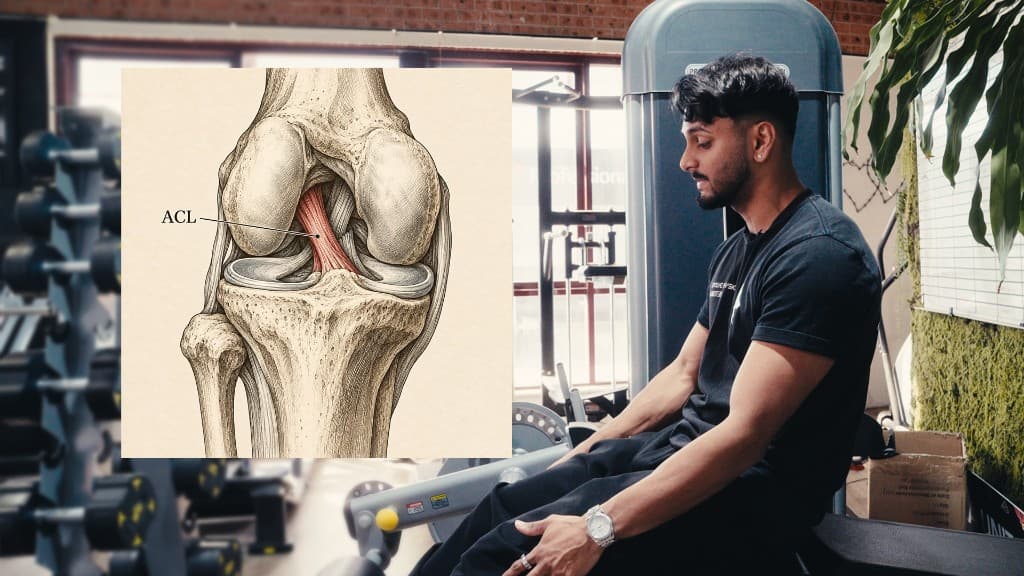
Patellar tendinopathy — jumper's knee — is pain at the patellar tendon insertion, just below the kneecap. Volleyballers, basketballers, netballers, and gym-goers who live in squat patterns know it well. The old advice was rest, ice, and wait. Tendons don't respond to that. They respond to progressive tensile load — heavy enough to stimulate remodelling, slow enough to stay below the pain threshold.
Pain monitoring rules
- During exercise: pain ≤3/10 is acceptable
- Next morning: pain should not be worse than baseline
- 24-hour rule: if pain spikes the day after, reduce load 20–30% and hold a week
The 12-week heavy-slow protocol
Weeks 1–4: Isometrics + heavy slow
- Spanish squat holds (or wall sit at 45° knee flexion): 5 × 45 sec, daily
- Heavy slow squat (tempo 3-0-3): 4 × 6 at RPE 7–8, 3×/week
- Decline single-leg squat (25° board): 3 × 8 per side, every second day
- Modify jumping volume — reduce by 50% or substitute low-impact conditioning
Weeks 5–8: Energy storage introduction
- Heavy slow continues 2×/week
- Countermovement jumps (submaximal): 3 × 5, 2×/week
- Hopping progressions — pogo → single-leg hops, pain-monitored
- Gradual return to sport-specific jumping drills at 50–70% intensity
Weeks 9–12: Return to full jumping
- Full-speed jumping and cutting in controlled sessions
- Monitor 24-hour pain response after each session
- Volume increases ≤10% per week
Supporting work you can't skip
- Hip abduction and external rotation strength — weak hips overload the patellar tendon
- Hamstring and calf capacity — the whole chain matters for jump landing
- Load management — sudden spikes in jump volume cause re-flares more than any single exercise
Connects to the knee & sport cluster
Basketball-specific loading: our basketball knee & ankle guide. Anterior knee pain without tendon focus: runner's knee guide. Returning to run after layoff: return to running framework. ACL history: ACL return-to-sport testing.
Book a jumper's knee assessment
Patellar tendinopathy is one of the most mistreated conditions in sport — usually because loading wasn't progressed properly. Book a physio assessment at Evolve Physio & Mastery, Cabramatta. We see jumping athletes from Liverpool, Fairfield, Bankstown and across Southwest Sydney.
References: Malliaras et al. 2013 patellar tendinopathy loading review; Beyer et al. 2015 heavy slow loading vs eccentric; van der Heijden et al. 2015 exercise for patellar tendinopathy.
Frequently Asked Questions
Should I stop jumping completely?
Not necessarily. Modern tendon rehab uses pain monitoring — keeping load at a level where pain stays ≤3/10 during activity and settles within 24 hours. Total rest deconditions the tendon; the goal is finding the load it can tolerate and progressing from there.
How long does patellar tendinopathy take to fix?
Most athletes need 8–12 weeks of consistent heavy-slow loading before returning to full jumping volume. Tendons remodel slowly — shortcuts show up as re-flares at week 6.
Do cortisone injections help?
Generally no for patellar tendinopathy. Evidence favours progressive loading over injections; cortisone can weaken tendon tissue long-term. Shockwave or PRP are sometimes discussed for recalcitrant cases — loading remains the foundation.
What's the difference between jumper's knee and runner's knee?
Jumper's knee (patellar tendinopathy) is pain at the bottom of the patella tendon, worst with jumping and heavy quadriceps loading. Runner's knee (patellofemoral pain) is usually around or behind the kneecap with running and stairs. Treatment differs — see our <a href="/blog/runners-knee-patellofemoral-pain-physio">runner's knee guide</a>.
When can I return to basketball or volleyball?
When you can perform: pain-free heavy Spanish squats, 25+ single-leg decline squats, hop tests within 10% symmetry, and 2–3 weeks of graded jumping progressions without next-day pain spikes.