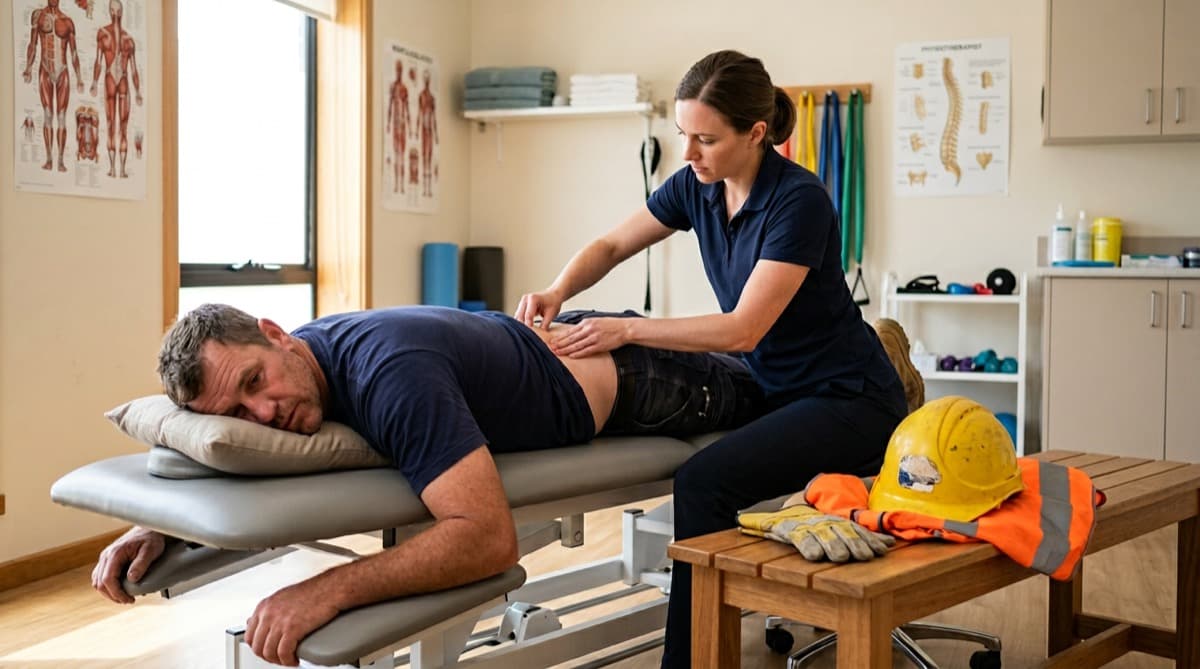
Truck Drivers and Chronic Back Pain on WorkCover NSW: Managing the Road and the Recovery
Chronic back pain is almost universal in trucking
Talk to any driver over 45 who's been in trucks since their 20s, and the conversation lands on the back. Sometimes the hip, the shoulder, the neck — but almost always the back. Long-haul drivers, local distribution, owner-operators, B-double drivers, courier and delivery work — the common thread is hours of sustained sitting in a vehicle that vibrates, accelerating and decelerating, often with significant lifting and unloading at either end of the trip. At Evolve Physio & Mastery in Cabramatta, we see drivers from across the trucking corridor — Yennora, Smithfield, Wetherill Park, Erskine Park, the Liverpool industrial estates, and the depots along the Hume and M5/M7 corridors.
This post is for drivers thinking about WorkCover, drivers already on a claim, and operators trying to keep injured drivers working safely.
Why driving hits the back so hard
- Sustained sitting in flexion. Lumbar discs are loaded most when you're seated, particularly in a slightly forward-leaning position. Compare disc pressure standing (100%) to sitting slumped (190%) — sitting is structurally harder on the lumbar spine than standing.
- Whole-body vibration. Heavy vehicle cabs transmit low-frequency vibration that's strongly associated with lumbar disc degeneration in epidemiology studies of long-term drivers.
- Asymmetric loading. Twisting to check mirrors, looking over the shoulder when reversing, foot pedals fixed in one position.
- Sudden lifting demands at delivery. Most driving injuries don't happen in the cab — they happen at the dock, with a sudden lift after 4 hours of sitting (worst possible mechanical setup for the lumbar disc).
- Restricted breaks and recovery. Schedules don't always allow proper stretch and movement breaks.
Acute vs. chronic — they need different management
Acute injury (sudden onset)
"I bent down to chain a load and couldn't straighten up." Classic acute lumbar episode. NSW WorkCover covers this when work-related. Standard pathway applies — see your GP for a Certificate of Capacity, report to your employer, start physio early. Most acute episodes settle in 4–8 weeks with the right management. Our WorkCover physio guide covers the system pathway. Our lower back pain piece covers clinical management.
Chronic / gradual onset
"My back's been giving me grief for the past three years and it's getting worse." This is the more common driver presentation. WorkCover does cover gradual-onset injuries aggravated by work — but the claim process is more nuanced. Documentation is critical:
- A specific event isn't required — but a clear pattern of work-related aggravation is.
- Keep a symptom diary tracking pain levels through work shifts vs. non-work days.
- See your GP early and get a Certificate of Capacity covering the work-related aggravation pattern.
- Expect the insurer to investigate more thoroughly than they would for an acute injury.
What 'returning to work' looks like for drivers
Trucking has more modified-duty options than most operators realise:
- Shorter routes — local distribution instead of long-haul, with breaks every 1–2 hours.
- Different vehicles — lighter vehicles often have better seating ergonomics.
- Yard duties — yard moves, vehicle inspections, paperwork.
- Loading dock supervision rather than physical loading.
- Dispatch or admin duties for a defined period during recovery.
- Mechanical inspection / pre-trip checks as a graded transition back to driving.
Plans depend on your employer's setup, the type of work they do, and your medical restrictions. A good return-to-work coordinator helps. Where the employer can't accommodate, vocational rehabilitation funded by the insurer can support retraining.
Heavy vehicle licence and medication — be careful here
Two issues create unnecessary risk for injured drivers:
- Pain medications and driving. Opioids, gabapentinoids (pregabalin / gabapentin) and some other medications can affect alertness and reaction time, even when you "feel fine." Australian fitness-to-drive standards take medication impairment seriously. Your prescribing doctor must discuss driving fitness when prescribing these. Don't drive on prohibited medication.
- Hiding symptoms during medicals. Heavy vehicle medical assessments under the Assessing Fitness to Drive standards must be honest. Hiding back pain to keep your medical clean creates legal exposure if you're later in an incident — and a properly documented WorkCover claim is a better long-term outcome than hidden chronic injury.
Practical things drivers can do today
- Seat setup — lumbar support, seat tilt, mirror positions checked at every shift change. Get a fitter or your fleet manager to help if needed.
- Get out at every stop — even 60 seconds of standing, walking, gentle extension reduces accumulated load.
- Lift correctly at deliveries — even when no one's watching. Hip hinge, load close to body, no twisting under load.
- Strength training off-shift — the protective effect of regular hip and lower back strength training in drivers is well established. 2x/week, 30 minutes, simple equipment.
- Sleep position — side-lying with a pillow between knees is the friendliest position for irritated lumbar discs.
The owner-driver and contractor question
This is where NSW workers compensation gets complicated. WorkCover covers "workers" — which includes employees and (under "deemed worker" provisions) some contractors performing work essentially the same as employees. Pure owner-operators running their own business with their own ABN, multiple clients, their own vehicle and their own books are typically not covered by WorkCover and rely on:
- Their own income protection insurance.
- Trauma / accident insurance.
- CTP if the injury occurred in a motor vehicle accident.
- Self-funded treatment with Medicare and private health rebates.
If you're not sure where you sit, SIRA's worker definition tool or a workers compensation lawyer can clarify before you're injured. After an injury isn't the best time to discover you weren't covered.
The long-game conversation
Some drivers come in hoping to get back to identical pre-injury duties forever. Honest assessment matters. For drivers in their late 50s and 60s with 30 years of cumulative load, the right goal might be:
- Stable, manageable pain that doesn't dominate life.
- Continued capacity for current work with sustainable modifications.
- Strength and mobility maintenance to prevent acute flares.
- A realistic transition plan if the body says the long-haul years are done.
That's not a defeatist conversation — it's a respectful one. Pretending a 60-year-old with 30 years of trucking can return to 14-hour driving days with zero modifications is a disservice. We have the honest version of this discussion with our patients.
Related reading
For the WorkCover system pathway, our WorkCover physio guide. For first-48-hour decisions, our first 48 hours guide. For chronic pain that lingers, our chronic pain management piece. For when to image, our MRI for back pain myth-buster.
Book a WorkCover physio assessment
If you're driving through pain — or you're worried about how a claim might affect your career — we'd rather have an honest first conversation than wait until things are worse. Book a WorkCover assessment at Evolve Physio & Mastery, Cabramatta. We see drivers from Liverpool, Fairfield, Canley Heights, Smithfield, Wetherill Park, Yennora, Eastern Creek and across the Southwest Sydney transport corridor. SIRA-aligned, all paperwork handled. For the system itself, our Workers Compensation Mastery Guide is plain English.
This article is general educational information about NSW workers compensation and physiotherapy. It is not legal or financial advice. For legal questions about your claim or your worker status, seek advice from a workers compensation lawyer. For fitness-to-drive questions, speak to your treating GP. References: SIRA NSW; icare NSW; Austroads Assessing Fitness to Drive 2022.
Frequently Asked Questions
Am I covered by WorkCover as an owner-driver or contractor?
It depends on the nature of your contract. 'Deemed workers' provisions in NSW workers compensation law can extend coverage to contractors performing work that is essentially the same as that of an employee. Owner-drivers operating their own business with their own ABN and multiple clients are typically not covered by WorkCover and need their own income protection or trauma insurance. SIRA's worker definition tool or a workers compensation lawyer can clarify your specific situation.
How quickly will my claim affect my heavy vehicle licence?
A WorkCover claim doesn't automatically affect your HC, MC or HR licence. Medical fitness to drive heavy vehicles is governed separately under the Assessing Fitness to Drive standards. If your injury or any prescribed medication affects your fitness to drive heavy vehicles, your treating doctor must be honest with you and Transport for NSW about it. Pushing through and driving impaired is dangerous and creates legal exposure on top of the injury.
I only have back pain when I drive — not at home. Is that still WorkCover?
Yes. Injuries aggravated by work are covered, even if they fluctuate. The work-related driving is the aggravating exposure; that's enough for coverage. The challenge is documenting it clearly — keep a symptom diary showing the pattern, and discuss it with your GP and physio.
Will I have to stop driving completely while on WorkCover?
Often no. Modified driving (shorter trips, local instead of long-haul, lighter vehicles, breaks every 1–2 hours instead of every 5) is a common return-to-work pathway for truck drivers. Full cessation is reserved for severe injuries or where ongoing driving is causing acute deterioration.
What if my employer says I have to take it or leave it on full-time long-haul?
You have a right to suitable duties consistent with your medical restrictions. Employers in NSW have a legal obligation to provide suitable employment as far as reasonably practicable. If your employer is unwilling or unable, the insurer can also fund vocational rehabilitation or retraining. A workers compensation lawyer can help if you're hitting walls.
How long does back pain recovery realistically take for a truck driver?
Highly variable. Acute episodes (sudden onset) often settle in 4–8 weeks with the right management. Chronic back pain that's been present for years is a different conversation — the goal usually shifts from 'cure' to capacity building, pain management, and sustainable work patterns. We've helped drivers stay on the road into their 50s and 60s with consistent maintenance work.