MRI for Back Pain: When You Actually Need One (and When It Will Just Worry You)
The MRI paradox
Here's a counterintuitive fact: routine MRI for back pain often makes outcomes worse, not better. People who get early imaging for non-specific low back pain have, on average, more pain, more disability, more surgery, more time off work, and worse long-term outcomes than people who don't. This isn't because the imaging missed something. It's because the imaging found 'things' that look scary on a report, that exist in pain-free people too, that drive fear-avoidance behaviour, and that often kick off a cascade of investigations and interventions that wouldn't have happened otherwise.
This isn't an argument against MRI when it's indicated. It's an argument against MRI when it isn't.
The base rates that change everything
Brinjikji et al. 2015 systematically reviewed MRI findings in pain-free people across decades of studies. The results, in people with no back pain at all:
- Age 20: 30% have disc degeneration, 29% have disc bulges.
- Age 30: 52% have disc degeneration, 40% have disc bulges.
- Age 40: 68% have disc degeneration, 50% have disc bulges.
- Age 50: 80% have disc degeneration, 60% have disc bulges.
- Age 60: 88% have disc degeneration, 69% have disc bulges.
- Age 70: 93% have disc degeneration, 77% have disc bulges.
These are people with no pain. So if a 45-year-old with back pain gets an MRI and the report says 'L4-L5 disc bulge, degenerative changes' — that finding is, statistically, more likely to be incidental than causative. The imaging hasn't proven anything about the pain.
When imaging IS indicated — the red flags
Australian and international clinical guidelines recommend imaging when one or more red flags are present:
- Significant trauma — fall from height, motor vehicle accident.
- Age over 50 with new back pain — particularly with no clear mechanical cause.
- History of cancer — especially cancers prone to spinal metastasis (breast, prostate, lung, kidney, thyroid, multiple myeloma).
- Unexplained weight loss.
- Fever or systemic symptoms.
- Night pain not relieved by position — pain that wakes you and isn't eased by changing position.
- Significant neurological signs — major leg weakness (e.g., foot drop), numbness in the saddle area, bladder or bowel changes, sexual dysfunction (suggests cauda equina — emergency).
- Immunocompromise — increased infection risk.
- IV drug use — increased epidural abscess risk.
- Long-term corticosteroid use — increased fracture risk.
- Severe pain not improving over 4–6 weeks of structured care.
- Persistent radicular pain (sciatica) that isn't improving and where surgical consultation is being considered.
If you have any of these, imaging is appropriate and often urgent. If you don't, structured physio and time is the better first step.
What MRI actually shows — and doesn't show
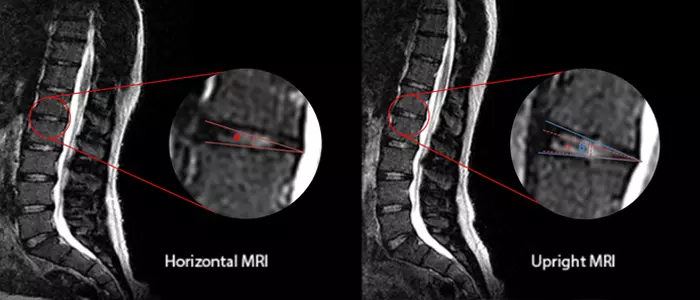
An MRI is an excellent imaging modality for soft tissue structures. It shows:
- Discs — hydration, bulging, herniation, sequestration.
- Nerve roots — compression or irritation.
- Spinal canal — narrowing (stenosis).
- Facet joints — degenerative changes, effusions.
- Bone — fractures (though CT is better for fine bone detail), bone edema (early stress reactions), tumours, infection.
- Spinal cord — most pathology.
- Surrounding soft tissues — muscles, ligaments.
What it doesn't show: pain. Pain isn't a structural finding. It's a brain output influenced by tissues, nervous system sensitivity, beliefs, sleep, stress and many other factors. This is why two people can have identical-looking MRIs and completely different pain and function.
The 'cascade' problem
A typical MRI report uses standardised language that sounds alarming to non-specialists. 'Annular fissure', 'disc desiccation', 'modic changes', 'facet arthropathy'. None of these terms in isolation indicate a problem requiring intervention. But when patients read these reports without context, the predictable cascade follows:
- Anxiety and fear about activity.
- Reduced movement to 'protect' the back.
- Deconditioning and increased stiffness.
- Worsening pain due to deconditioning.
- Further consultations, often with multiple specialists.
- Sometimes injections, sometimes surgery.
- Pain often persists or worsens.
This isn't theoretical. Multiple large studies (Webster et al. 2013, Jarvik et al. 2003) show worse outcomes in patients who receive early imaging for non-specific low back pain compared to matched controls who don't.
What to do if you've had an MRI with 'findings'
If you've had a scan and the report has multiple findings — disc bulges, degenerative changes, facet arthropathy — get them interpreted in clinical context. A good physio or sports doctor can:
- Correlate the findings with your specific pain pattern.
- Identify which findings (if any) are likely relevant.
- Provide reassurance about findings that are likely incidental.
- Build a management plan based on function, not on the report.
A disc bulge at L4-L5 in someone with central back pain only and no leg symptoms is probably not the driver of the pain, regardless of how it reads.
The cost question
In Australia, lumbar MRI:
- Bulk-billed MRI — limited availability, usually with specialist referral for eligible items.
- Medicare-rebated MRI — requires referral from a specialist for specific eligible items. GP referrals for non-acute back pain rarely attract Medicare rebate.
- Private/self-funded MRI — typically $300–$500 out of pocket. Some imaging providers offer competitive cash prices.
- Public hospital MRI — through public system referral, often with significant wait times for non-urgent cases.
Cauda equina syndrome — the medical emergency
This deserves separate mention. Cauda equina syndrome is a rare but serious condition where the nerve roots at the base of the spinal cord are compressed. Features:
- Bilateral leg pain, weakness or numbness.
- Numbness in the saddle area (the area that would touch a saddle when sitting).
- Bladder dysfunction — difficulty urinating, urinary retention, or new incontinence.
- Bowel dysfunction — new incontinence or constipation.
- Sexual dysfunction.
This is a same-day surgical emergency. If you have any of these features, present to an emergency department.
The pragmatic first-line approach to back pain
- Rule out red flags — comprehensive history and examination.
- Provide reassurance and education — most back pain is mechanical, common, and recovers well.
- Stay active — bed rest is harmful. Modified activity within tolerance is the goal.
- Structured rehab — progressive exercise, manual therapy as adjunct.
- Review at 4–6 weeks — if no improvement, reconsider; imaging may be appropriate at this stage if the picture isn't clear.
- Imaging only when indicated — not as a substitute for assessment.
This approach is supported by every major back pain guideline published in the last decade.
When physio recommends imaging
We do refer for imaging when it's indicated. Examples:
- Persistent radicular pain (sciatica) not responding to 6+ weeks of care, where surgical consultation may be appropriate.
- Significant or progressive neurological signs.
- Suspicion of stress fracture in a young athlete with the right pattern (e.g., fast bowler — see our cricket fast bowling post).
- Red flag features identified during ongoing care.
- Surgical planning if surgery is being considered.
The bottom line
An MRI is a tool. Used in the right clinical context, it's invaluable. Used as a default for typical back pain, it usually doesn't help and often hurts. If you're considering an MRI for back pain, the most useful first question isn't 'can I get a scan?' — it's 'what's actually driving my pain, and what's the best first step?'
Related reading
For typical back pain management, see our lower back pain physio guide. For sciatica specifically, our sciatica vs lower back pain piece.
Book a back pain assessment
If you've had a scan you're worried about, or you're trying to decide whether to push for one — get a proper assessment first. Book at Evolve Physio & Mastery, Cabramatta. We see patients with back pain from across Liverpool, Fairfield, Canley Heights, Bankstown and Southwest Sydney, and we'll give you a straight answer on what imaging (if any) will actually help.
References: Brinjikji et al. 2015 'Systematic literature review of imaging features of spinal degeneration in asymptomatic populations' (AJNR); Jarvik et al. 2003 'Rapid magnetic resonance imaging vs radiographs for patients with low back pain' (JAMA); Webster et al. 2013 early MRI and disability in low back pain (Spine); Australian Acute Musculoskeletal Pain Guidelines.
Frequently Asked Questions
Will my GP send me for an MRI for my back pain?
Not in most cases of typical low back pain — and that's evidence-based, not cost-cutting. Australian and international guidelines recommend imaging only when red flags are present or when there's a specific clinical reason that will change management. For most back pain, 4–6 weeks of structured care is the first step.
What if the MRI shows a disc bulge?
Disc bulges and degenerative changes are extremely common on MRI in pain-free people — by age 50, around 60% of pain-free people have at least one disc bulge. The presence of a bulge doesn't mean it's the cause of your pain. Clinical correlation is essential, which is why imaging in isolation is unhelpful.
How much does a lumbar MRI cost?
Bulk-billed lumbar MRIs are available through public referral pathways in some cases, but most private MRIs cost around $300–$500 out of pocket. A non-bulk-billed scan with referral from a GP or specialist for an eligible Medicare item attracts a rebate, but routine GP-requested lumbar MRIs are usually not Medicare-rebatable.
Can I refer myself for an MRI?
Some imaging providers accept self-referral, but the scan won't attract Medicare rebate and you'll pay the full cost. More importantly, an MRI without a clinical question to answer is rarely useful and often counterproductive — incidental findings can drive anxiety and unnecessary further investigation.
When is imaging actually urgent?
Red flags include: significant trauma, age >50 with new back pain, history of cancer, unexplained weight loss, fever, night pain not relieved by position, neurological symptoms (significant leg weakness, numbness in the saddle area, bladder or bowel changes), and severe pain not improving over 4–6 weeks. Any of these warrant prompt assessment.
If I have a herniated disc, do I need surgery?
Most disc herniations causing back pain and even sciatica improve significantly with conservative management (physio, time, sometimes a short course of medication) over 6–12 weeks. Surgical referral is considered for persistent severe pain not responding to conservative care, or for cauda equina syndrome (which is an emergency).