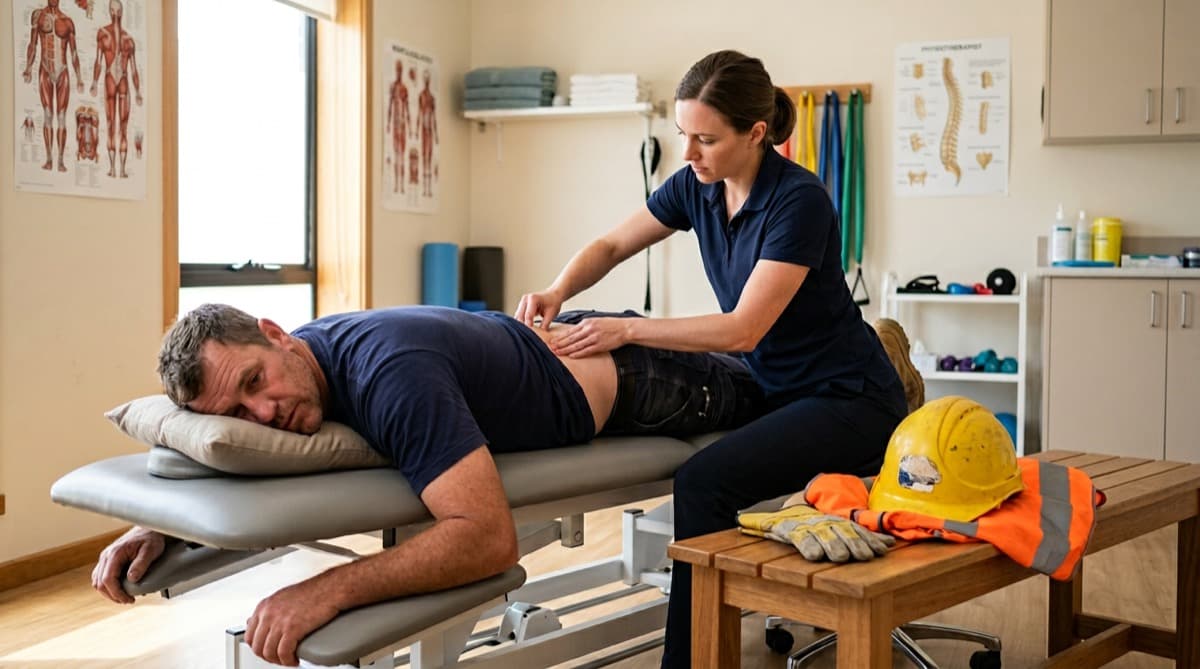
Stress, Anxiety and Depression on a Long WorkCover Claim: What Physio Can (and Can't) Do
The cost nobody warns you about
If you've been on a workers compensation claim for more than 6 months, you already know what this post is about. The physical injury is one chapter of the story. The longer the claim goes, the more the other chapters start to dominate — the loss of your work routine, the stress of fortnightly check-ins and paperwork, the financial pressure, the unwanted intimacy with case managers you've never met, the strange social dislocation of not being where you usually are with the people you usually see, and the slow erosion of confidence in your own body. At Evolve Physio & Mastery in Cabramatta, this is a conversation we have with patients on long WorkCover claims every week, particularly from across Liverpool, Fairfield, Bankstown and the broader Southwest Sydney corridor.
The research on this is unambiguous. Long workers compensation claims are independently associated with anxiety, depression, sleep disorders and pain catastrophising — over and above whatever the original physical injury was. This isn't a personal failure or weakness. It's a predictable response to a difficult situation. And it changes how recovery should be managed.
Why long claims hit mental health so hard
Multiple factors stack up:
- Loss of work identity. For many people, work is a significant part of self-image. Extended absence creates identity vertigo, particularly in trades and physical occupations.
- Loss of routine. The structure of getting up, going somewhere, doing something, coming home, sleeping — when it disappears, everything else drifts.
- Loss of social contact. Work is a major source of daily social interaction. Many injured workers experience meaningful social isolation by month 3–6.
- Financial pressure. Weekly payments are typically below pre-injury earnings. Bills don't drop.
- Bureaucratic burden. The fortnightly paperwork, case manager contact, GP visits, medical certificates, AHRRs, and occasional IME or FCE assessments are a low-grade ongoing stressor.
- Pain itself. Chronic pain has well-documented effects on mood, sleep and cognition — and the mood and sleep effects feed back into the pain.
- Uncertainty about the future. Will you ever be the same? What if you can't return? What happens to your career?
- The 'identity hit' of being on workers compensation. For some people, particularly tradies and high-earning professionals, the identity of being "an injured worker" is uncomfortable in itself.
What physio can genuinely help with
Modern physiotherapy is a biopsychosocial discipline — bodies don't recover in isolation from minds, contexts, beliefs and meaning. Where good physio adds real value beyond hands-on treatment:
- Pain education. Understanding how pain actually works — that hurt isn't always harm, that pain can persist after tissues have healed, that movement is generally safe even when uncomfortable — reduces fear and improves outcomes.
- Graded exposure to feared movements and tasks. The slow, structured re-introduction of movements people are avoiding, with reassurance and pacing.
- Collaborative goal setting. Re-establishing a sense of agency through small, achievable, meaningful targets.
- Sleep, exercise and lifestyle support. All major modifiers of pain and mood — and amenable to coaching alongside formal mental health care.
- Addressing pain catastrophising patterns through movement. Reducing the "magnification → helplessness → focus" loop through demonstrated capability.
- Re-establishing identity through capability. Doing hard things and noticing you can — the gym, the rehab task, the walk you couldn't do last month — rebuilds self-image in a way no conversation can.
- Coordination with your wider team. A good physio talks to your GP, case manager and psychologist (if you have one) so the messaging is consistent.
What physio can't do (and shouldn't pretend to)
- Diagnose psychological injury. That's the GP and psychologist's role.
- Provide formal psychological treatment. CBT, EMDR, ACT and other evidence-based psychological therapies are delivered by psychologists, not physios.
- Manage active psychiatric conditions. Depression with suicidal ideation, severe anxiety, PTSD — these need specialist mental health input.
- Replace appropriate medication. Where medication is clinically indicated, that's a conversation between you, your GP and (if needed) a psychiatrist.
- Handle complex psychological injury claims. These often need a lawyer's input alongside clinical care.
Pretending physio can do all this is harmful. So is dismissing the mental health dimension as 'not the physio's problem.' The right model is collaborative care — physio, GP, psychologist, lawyer (where relevant), case manager — pulling in the same direction.
Pain catastrophising — what it actually is and why it matters
Pain catastrophising is a measurable cognitive-emotional pattern with three components:
- Rumination — "I can't stop thinking about how much it hurts."
- Magnification — "I'm afraid that the pain will get worse / something serious is wrong."
- Helplessness — "There's nothing I can do to reduce the intensity of the pain."
It's strongly associated with worse pain intensity, more disability, and worse return-to-work outcomes. It's also modifiable. The Pain Catastrophising Scale (PCS) is a standard outcome measure we sometimes use in clinic. We don't 'pathologise' patients with this language — but recognising the pattern is the first step in changing it.
Sleep — the most underrated lever
Sleep disruption is almost universal in long pain claims and amplifies almost every other dimension. Pain disrupts sleep; poor sleep amplifies pain; the loop accelerates. Practical sleep interventions are often the highest-leverage thing we discuss:
- Consistent wake time, even on bad nights.
- Light exposure within 30 minutes of waking.
- Reduced screen time in the 60 minutes before bed.
- Bedroom temperature, darkness, noise.
- Caffeine cut-off before midday.
- Pain medication timing review with the GP.
- Limiting daytime napping to a single 20-minute window.
- Sleep position and pillow review for spinal pain.
When and how to bring psychology into the picture
The case for involving a psychologist earlier rather than later:
- For claims expected to extend beyond 3 months, brief psychological input shows benefit in multiple high-quality trials.
- For pain catastrophising, fear-avoidance, or persistent anger / frustration — psychology adds tools that physio alone can't.
- For depression, anxiety or trauma symptoms — psychology is the appropriate primary modality, often alongside GP-led pharmacological management.
- For complex claims involving conflict with employer or insurer — psychological support can help maintain perspective and energy.
How to get psychology involved on a NSW WorkCover claim:
- Discuss with your GP. Mental Health Care Plans (Medicare) and workers compensation-funded psychology can both be options depending on your situation.
- Your physio can support the case for psychology in the AHRR submitted to the insurer.
- For psychological injury as a claim category in itself, see your GP and consider a workers compensation lawyer.
The financial and life-admin stressors
Outside the clinical conversation:
- Financial counselling — free services through the National Debt Helpline (1800 007 007) and community organisations like The Salvation Army Moneycare. Most WorkCover insurers also have hardship programs.
- Legal advice — many workers compensation lawyers offer free initial consultations. WIRO (Workers Compensation Independent Review Office) provides free legal services for workers in some disputes.
- Multilingual support — every NSW insurer must provide interpreter services at no cost.
- Community support groups — peer support for chronic pain and injury exists across Sydney, including in suburbs like Liverpool, Bankstown and Cabramatta.
Returning to identity, not just to work
The ultimate goal isn't just 'fit for pre-injury duties.' It's regaining the version of yourself that work was part of — confidence in your body, capacity to participate, connection to people, contribution to something. Physical recovery is a necessary but not sufficient piece of that. The patients who do best on long claims usually share a few things: they keep moving even when it's hard, they re-establish small routines early, they accept help across multiple domains, and they treat the claim as a season of life rather than a definition of who they are.
Related reading
For chronic pain in more depth, our chronic pain management guide. For the WorkCover system, our WorkCover physio guide. For the first 48 hours after a workplace injury, our first 48 hours guide.
Book a WorkCover physio assessment
If you're on a long claim and the conversation has stopped feeling like progress, we can help. We work as part of a team — your GP, your case manager, your psychologist (or supporting the case for one) — to keep recovery moving on every dimension that matters. Book an assessment at Evolve Physio & Mastery, Cabramatta. We see injured workers from across Liverpool, Fairfield, Canley Heights, Bonnyrigg, Bankstown, Smithfield, Wetherill Park and Southwest Sydney. For the system itself in plain English, our Workers Compensation Mastery Guide.
This article is general educational information about NSW workers compensation, chronic pain and physiotherapy. It is not psychological treatment, legal advice or financial advice. For mental health support, please see your GP, contact Lifeline (13 11 14), or call Beyond Blue (1300 22 4636). For psychological injury workers compensation claims, consider speaking with a workers compensation lawyer. References: SIRA NSW; Sullivan et al. Pain Catastrophising Scale literature; Australian Pain Society 2024 chronic pain management guidelines.
Frequently Asked Questions
Can I claim WorkCover for psychological injury caused by a long physical claim?
Sometimes — but it's a separate, more complex claim category. NSW workers compensation covers psychological injury where work (including the original injury and its management) is the 'main contributing factor.' The threshold and assessment process is more involved than for physical injury. Discuss with your GP and consider speaking to a workers compensation lawyer specialising in psychological claims.
Will my insurer fund psychology sessions if my main injury is physical?
Often yes, where psychology is reasonably necessary for recovery from the work-related injury. The treating GP and physio can support the case for psychology involvement in the recovery plan. Allied Health Recovery Requests can include psychology where appropriate.
Why do I feel worse mentally now than when the injury first happened?
It's common, and there's good evidence for why. The first 4–12 weeks of an injury are often dominated by acute pain and the focus is on physical recovery. Beyond 3 months, the impact on identity, income, relationships, and future planning becomes harder to ignore. Loss of work routine, social contact, financial stress, and the bureaucratic burden of the claim itself all compound. This is not weakness — it's a predictable response to a difficult situation.
What's pain catastrophising and how does physio address it?
Pain catastrophising is the cognitive and emotional pattern of magnifying pain (rumination, helplessness, focused attention). It's strongly associated with worse pain outcomes — but it's also modifiable. Physios trained in cognitive functional therapy and pain education can address it directly through education, graded exposure to feared movements, and collaborative goal setting. For more entrenched patterns, psychology adds another layer.
Is it normal to feel angry at my employer / the insurer / the system?
Yes, and it's often a rational response to a frustrating experience. The challenge is that anger that drives action (advocating for yourself, finding the right professionals) is useful; anger that becomes rumination and helplessness compounds the pain experience. Working with a psychologist can help separate the two.
Should I see a psychologist if I'm 'just' dealing with a physical injury?
Earlier than you think — particularly if the claim is going past 3 months. The evidence for early psychological input in complex pain and prolonged injury claims is strong. Asking for help is not an admission of psychological injury, just like asking for physio isn't an admission of weakness.