5 Common Tendon Injuries (And How Physio Actually Helps)
Tendons are tougher than you think — and trickier to rehab
Tendons connect muscle to bone. They're remarkably strong, but they're also slow to adapt and slow to heal. When we ask too much of a tendon — too much load, too soon, too often — it grumbles. That grumble is what most people call "tendonitis," but in reality it's almost always tendinopathy: a failed healing response in the tendon's collagen structure, not a classic inflammatory condition.
That distinction matters. The old "rest and ice" advice doesn't fix tendinopathy — and neither do anti-inflammatories on their own. What does work, with very strong evidence behind it, is progressive loading: structured, gradually increasing exercise that stimulates the tendon to remodel and become stronger. At Evolve Physio & Mastery in Cabramatta we work with tendinopathies every week, and the results when patients commit to the program are excellent.
Here are the five tendon injuries we see most often, and what good rehab looks like for each.
1. Achilles tendinopathy
The Achilles is the largest tendon in the body, connecting your calf to your heel bone. Achilles tendinopathy classically presents as morning stiffness, pain at the start of activity that warms up, and tenderness about 2–6cm above the heel (mid-portion) or right at the heel insertion.
Common in runners, walkers, and anyone who has recently increased mileage or hill work. Risk factors include weak calves, sudden training jumps, footwear changes, and previous injury.
What rehab looks like: a graded calf-loading program (typically heavy-slow resistance or isometric loading early, progressing to eccentric and plyometric work), addressing calf flexibility and ankle mobility, and managing training load. Most people improve significantly within 12 weeks.
2. Patellar tendinopathy ("jumper's knee")
Pain just below the kneecap that flares with jumping, landing, deep squats, or running downhill. Common in basketball, volleyball, AFL, soccer, and CrossFit-style training.
What rehab looks like: isometric quad loading (Spanish squats, wall sits) to manage pain in the early phase, progressing to heavy-slow resistance training (slow tempo squats, leg press, decline squats) over 8–12 weeks, then introducing the sport-specific demands like landing and cutting. We also assess the rest of the kinetic chain — weak glutes and stiff ankles often offload onto the patellar tendon.
3. Rotator cuff tendinopathy
The rotator cuff is a group of four small muscles that stabilise the shoulder. Tendinopathy here typically presents as pain reaching overhead, lifting, or sleeping on the affected side. It's extremely common in office workers, tradies, and anyone over 40 — the prevalence climbs steadily with age.
What rehab looks like: high-quality evidence supports progressive shoulder strengthening (rotator cuff and scapular stabilisers) as first-line treatment, with similar long-term outcomes to surgery for most non-traumatic cases. Hands-on therapy, dry needling, and posture work all play supporting roles. Plan on 8–12 weeks for meaningful change.
4. Lateral epicondylalgia (tennis elbow)
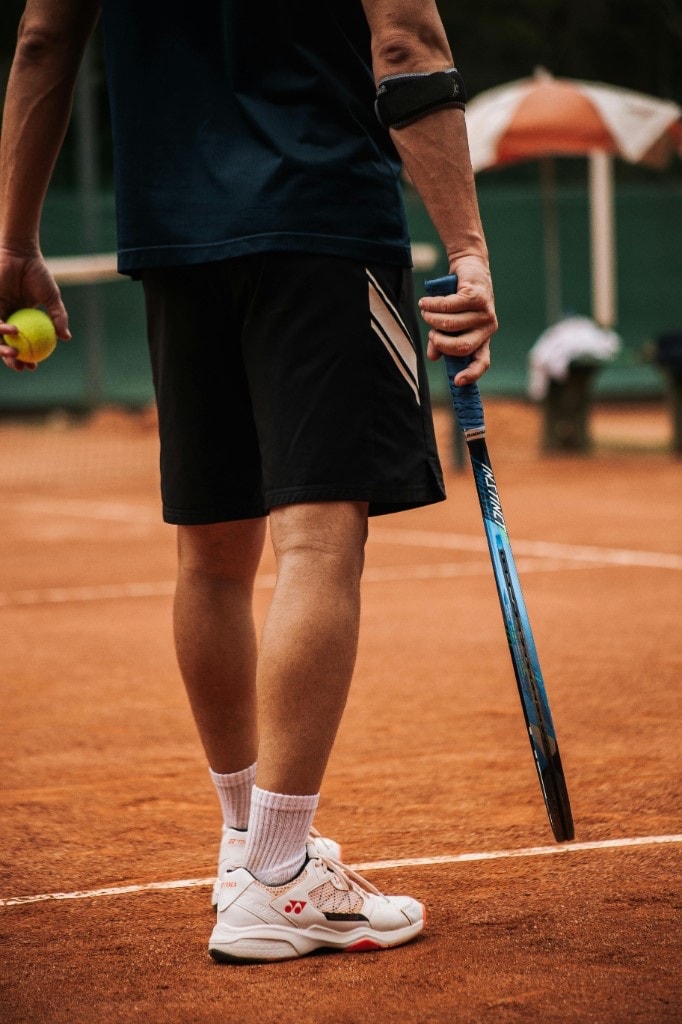
Pain on the outside of the elbow, often referring down the forearm. Despite the name, only about 5% of cases come from tennis — most come from work-related repetitive gripping (tradies, office workers, hairdressers, parents lifting kids).
What rehab looks like: isometric wrist extensor loading early to settle pain, progressing to heavy-slow resistance for the wrist extensors and grip. We also assess and treat the shoulder and neck — these often contribute to forearm overload. Education on workload modification is critical: cortisone injections are generally avoided here as evidence shows worse long-term outcomes.
5. Gluteal tendinopathy
Pain on the outside of the hip — over the bony prominence (greater trochanter) — that's worse lying on that side, walking up hills, or standing on one leg to put on pants. Most common in women over 40, and often misdiagnosed as bursitis.
What rehab looks like: education to avoid hip-loading positions (don't sit cross-legged, don't stand "hanging" on one hip), and a progressive glute strengthening program targeting glute medius and minimus. The LEAP trial (a large Australian RCT) showed education plus exercise was significantly more effective than cortisone injection at 12 months. Plan on at least 12 weeks of consistent work.
Why the right loading is everything
The common thread across all five conditions is load management. Too little load and the tendon stays weak and painful. Too much, too soon, and it flares. The job of your physio is to find — and progress — the right dose. That's why generic exercises pulled off the internet often disappoint: they're not progressed in line with how your tendon is responding.
At Evolve Physio & Mastery in Cabramatta, every tendinopathy program is individualised based on your assessment, your sport or work demands, and how your tendon responds week to week.
Get a tendon assessment in Cabramatta
If you've been nursing a sore Achilles, knee, shoulder, elbow, or hip for more than a few weeks, it's time to get it properly assessed. Tendons respond brilliantly to the right loading — and frustratingly poorly to almost everything else.
Free Mastery guides that match these tendons
Our Knee Pain Mastery Guide and Shoulder Mastery Guide cover the style of loading we use in clinic for patellar, Achilles and rotator-cuff issues; the Back Pain Mastery Guide helps when spinal drivers load the leg or arm. View all programs.
Book a tendon assessment at Evolve Physio & Mastery in Cabramatta and let's get a clear plan in place.
Frequently Asked Questions
What's the difference between tendinitis and tendinopathy?
Tendinitis implies acute inflammation. Modern research shows that most longer-term tendon problems are not primarily inflammatory — they're a failed healing response with structural changes in the tendon. That's why anti-inflammatories alone rarely fix them and why progressive loading is the cornerstone of treatment.
Should I rest a sore tendon?
Complete rest usually makes tendons worse, not better. Tendons need load to heal and remodel. Your physio will help you find the right level — enough to stimulate adaptation, not so much that you flare it up.
How long does tendinopathy take to recover?
Realistically, 8–12 weeks for most tendinopathies and longer (3–6 months) for stubborn cases like gluteal or chronic Achilles tendinopathy. The good news: with the right loading program, the success rate is very high.
Are cortisone injections useful for tendon problems?
Cortisone can give short-term pain relief but multiple high-quality studies show worse long-term outcomes for many tendinopathies (especially tennis elbow and Achilles). It's a tool to consider carefully with your GP — not a fix.
Will my tendinopathy come back?
It can if the underlying cause isn't addressed — usually a load that was too high, too soon, for the tissue's capacity. A good rehab program builds tendon capacity higher than the demands of your sport or work, which is the real protection against recurrence.